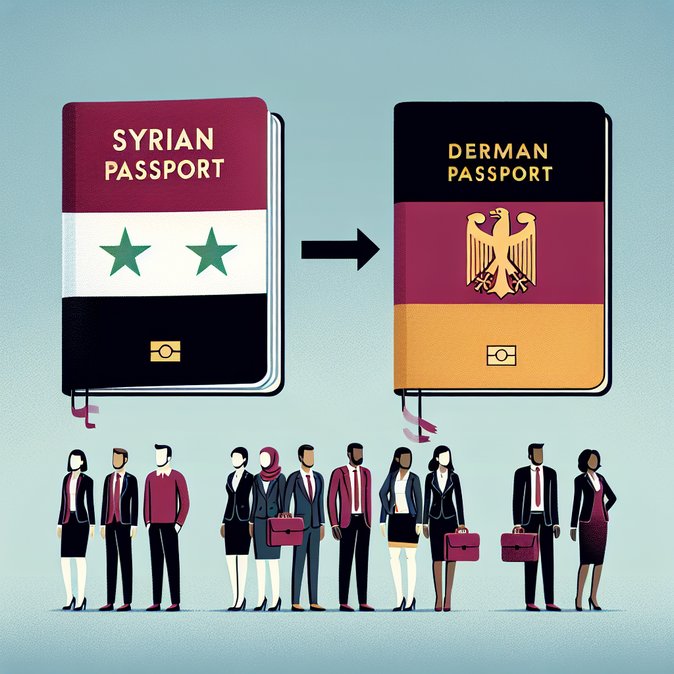
Fresh Interior Ministry statistics show that as of end-November 2025 only 940,401 people in Germany still held Syrian citizenship—34,000 fewer than a year earlier. The decline is driven almost entirely by record naturalisations rather than departures: Syria has ranked among the top three origin countries for new German citizens for three consecutive years.
The data arrive as Berlin prepares to host Syria’s transitional president Ahmed al-Scharaa for talks on reconstruction and refugee return. While the CSU is calling for an ‘Abschiebe-Offensive’ once the civil war ends, opposition parties point to the numbers as evidence that most Syrians have integrated and should receive permanent status. Only 3,707 Syrians left Germany under voluntary-return programmes in 2025, and forced removals remain rare—federal police escorted just three criminals back to Damascus last year.
![Number of Syrian nationals in Germany falls below one million—thanks to naturalisation, not returns]()
For employers running Blue-Card or apprenticeship schemes, the trend means a growing pool of bilingual talent eligible for EU-wide mobility once they acquire a German passport. It also eases quota management, as naturalised workers no longer count against labour-migration caps tied to third-country nationals.
HR and mobility teams should update internal nationality records: once citizenship is granted, employees lose Syrian consular-processing requirements but gain EU freedom of movement. Corporate travel policies may need revision to reflect new visa-free access across Schengen and beyond.
Politically, the figures feed into Germany’s debate over reinstating returns after a notional end to the Syrian conflict; businesses that employ large numbers of Syrians should monitor any policy shifts that could affect family-reunification or residency rights. (upday.com)
The data arrive as Berlin prepares to host Syria’s transitional president Ahmed al-Scharaa for talks on reconstruction and refugee return. While the CSU is calling for an ‘Abschiebe-Offensive’ once the civil war ends, opposition parties point to the numbers as evidence that most Syrians have integrated and should receive permanent status. Only 3,707 Syrians left Germany under voluntary-return programmes in 2025, and forced removals remain rare—federal police escorted just three criminals back to Damascus last year.

For employers running Blue-Card or apprenticeship schemes, the trend means a growing pool of bilingual talent eligible for EU-wide mobility once they acquire a German passport. It also eases quota management, as naturalised workers no longer count against labour-migration caps tied to third-country nationals.
HR and mobility teams should update internal nationality records: once citizenship is granted, employees lose Syrian consular-processing requirements but gain EU freedom of movement. Corporate travel policies may need revision to reflect new visa-free access across Schengen and beyond.
Politically, the figures feed into Germany’s debate over reinstating returns after a notional end to the Syrian conflict; businesses that employ large numbers of Syrians should monitor any policy shifts that could affect family-reunification or residency rights. (upday.com)
Source: Upday