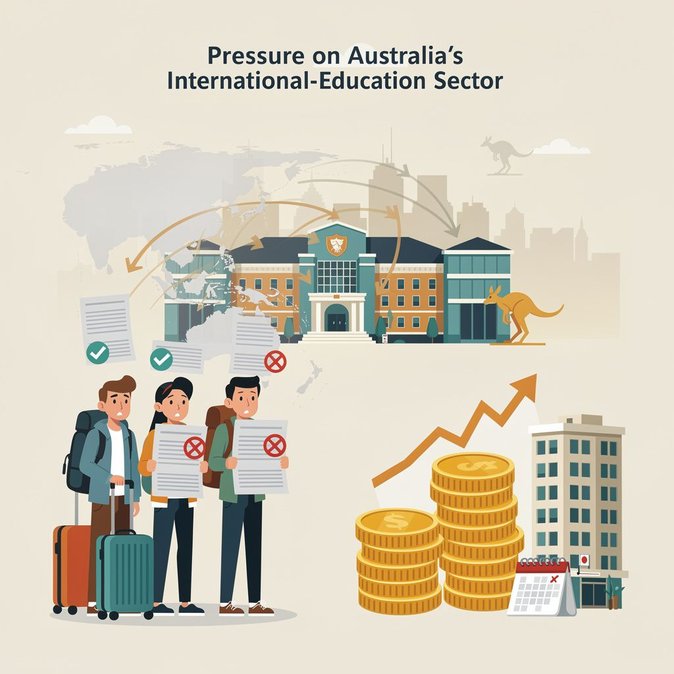
An ABC investigation published in the early hours of 12 June has spotlighted a growing perfect storm for Australia’s half-million international students: weaker home-country currencies, higher living costs and a tougher migration environment. Education agents told the broadcaster that visa refusal rates for some South-Asian markets have risen above 25 per cent since March, coinciding with the Department of Home Affairs’ integrity crackdown.
Amid these shifting conditions, VisaHQ can help prospective students and education agents stay ahead of the rule changes by providing real-time visa requirements, personalised document checklists and online filing tools through its Australia portal (https://www.visahq.com/australia/). Using the platform to pre-screen applications can reduce the likelihood of refusals and ensure that financial-capacity proofs meet the new benchmarks.
Compounding the pain, currencies such as the Vietnamese dong and Bangladeshi taka have fallen 10-15 per cent against the Australian dollar since January 2026. Students who budgeted at AU$24,505—the official financial-capacity benchmark—now face real costs closer to AU$27,000 per year, pushing many into gig-economy work beyond the 48-hour-per-fortnight cap. Universities Australia warns that the trend could derail the sector’s forecast AU$50 billion contribution to GDP if enrolments from price-sensitive markets slump. Policy-wise, the Albanese Government has resisted lobbying to restore unlimited work rights, arguing that temporary migrants should not be used to fill chronic labour shortages. Instead it plans to raise the financial-capacity requirement again on 1 July and to introduce ‘risk-tiered’ evidentiary demands that mirror the UK system. For institutions, the immediate task is to diversify recruitment towards markets with stronger currencies—such as the US and Europe—and to expand hardship funds. Businesses that rely on student labour in hospitality and aged care may also feel the pinch if visa grants slow further.
Amid these shifting conditions, VisaHQ can help prospective students and education agents stay ahead of the rule changes by providing real-time visa requirements, personalised document checklists and online filing tools through its Australia portal (https://www.visahq.com/australia/). Using the platform to pre-screen applications can reduce the likelihood of refusals and ensure that financial-capacity proofs meet the new benchmarks.
Compounding the pain, currencies such as the Vietnamese dong and Bangladeshi taka have fallen 10-15 per cent against the Australian dollar since January 2026. Students who budgeted at AU$24,505—the official financial-capacity benchmark—now face real costs closer to AU$27,000 per year, pushing many into gig-economy work beyond the 48-hour-per-fortnight cap. Universities Australia warns that the trend could derail the sector’s forecast AU$50 billion contribution to GDP if enrolments from price-sensitive markets slump. Policy-wise, the Albanese Government has resisted lobbying to restore unlimited work rights, arguing that temporary migrants should not be used to fill chronic labour shortages. Instead it plans to raise the financial-capacity requirement again on 1 July and to introduce ‘risk-tiered’ evidentiary demands that mirror the UK system. For institutions, the immediate task is to diversify recruitment towards markets with stronger currencies—such as the US and Europe—and to expand hardship funds. Businesses that rely on student labour in hospitality and aged care may also feel the pinch if visa grants slow further.