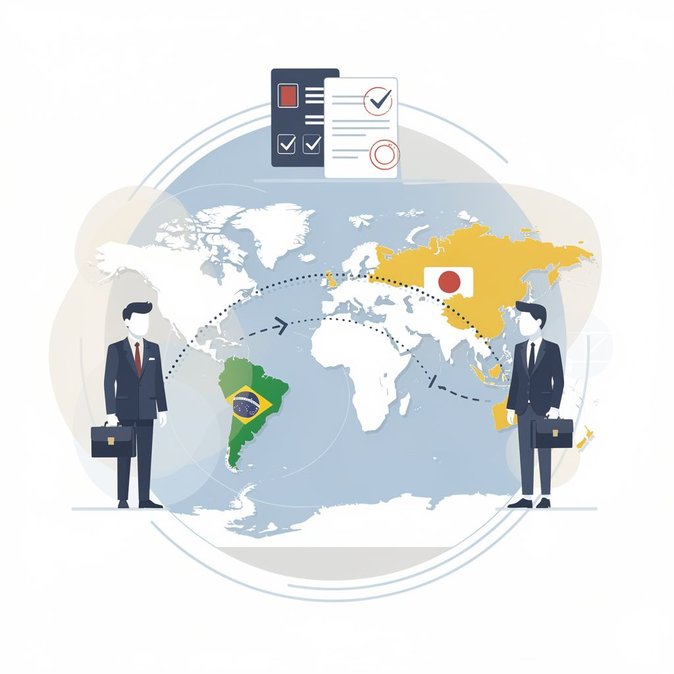
During a bilateral meeting on the sidelines of the G7 Summit in Évian on 16 June, Japanese Prime Minister Sanae Takaichi and President Luiz Inácio Lula da Silva announced the start of talks for a Japan–MERCOSUR Economic Partnership Agreement (EPA). The leaders instructed their teams to explore provisions on business-traveller facilitation, digital trade and mutual recognition of professional qualifications.
For companies already rotating employees between Japan and South America, staying on top of changing entry rules can be a burden. VisaHQ’s online platform—https://www.visahq.com/brazil/—streamlines visa and travel-document processing for Brazilian, Japanese and third-country nationals alike, flagging current exemptions and expediting business-visitor or work-permit applications so firms can keep critical projects moving while governments negotiate longer-term solutions.
Although negotiations are at an early stage, both sides highlighted the potential to harmonise short-stay visa exemptions for service providers and to create an APEC-style fast-track card for executives covering Brazil, Argentina, Paraguay and Uruguay. Japanese companies employ more than 200 000 people in Brazil, and smoother intra-company transfers are a longstanding demand of Keidanren and Brazil’s National Confederation of Industry. The summit also launched a bilateral dialogue on artificial-intelligence governance and a separate track on economic security, signalling that talent mobility will become central to wider strategic cooperation. Any EPA would still require alignment with ongoing EU-MERCOSUR discussions, but officials aim for a scoping paper by December 2026. Multinationals should follow the talks closely: past Japanese EPAs have included generous business-visitor waivers and streamlined work-permit quotas, which could significantly reduce assignment lead-times for both Brazilian and Japanese firms once implemented.

For companies already rotating employees between Japan and South America, staying on top of changing entry rules can be a burden. VisaHQ’s online platform—https://www.visahq.com/brazil/—streamlines visa and travel-document processing for Brazilian, Japanese and third-country nationals alike, flagging current exemptions and expediting business-visitor or work-permit applications so firms can keep critical projects moving while governments negotiate longer-term solutions.
Although negotiations are at an early stage, both sides highlighted the potential to harmonise short-stay visa exemptions for service providers and to create an APEC-style fast-track card for executives covering Brazil, Argentina, Paraguay and Uruguay. Japanese companies employ more than 200 000 people in Brazil, and smoother intra-company transfers are a longstanding demand of Keidanren and Brazil’s National Confederation of Industry. The summit also launched a bilateral dialogue on artificial-intelligence governance and a separate track on economic security, signalling that talent mobility will become central to wider strategic cooperation. Any EPA would still require alignment with ongoing EU-MERCOSUR discussions, but officials aim for a scoping paper by December 2026. Multinationals should follow the talks closely: past Japanese EPAs have included generous business-visitor waivers and streamlined work-permit quotas, which could significantly reduce assignment lead-times for both Brazilian and Japanese firms once implemented.