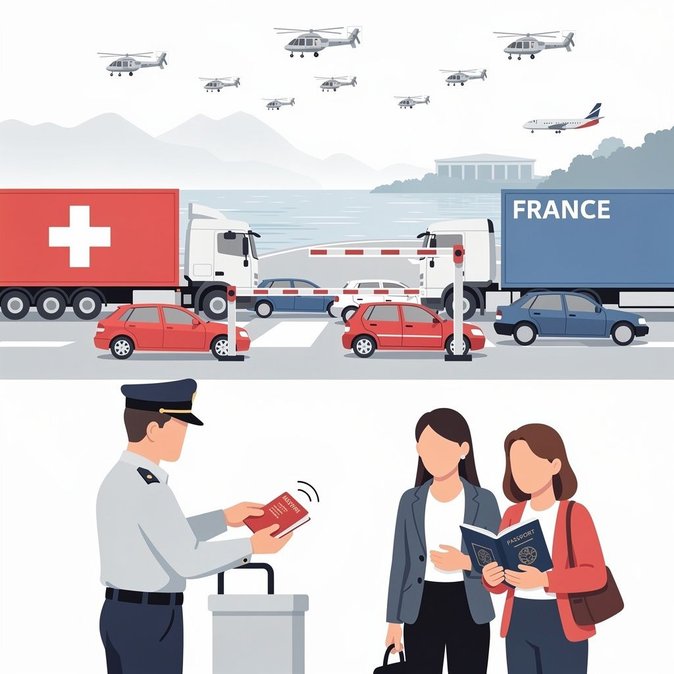
Business travelers heading to western Switzerland this week still need to pack their passports. Switzerland’s Federal Council invoked the Schengen Borders Code to re-introduce controls at its land and lake borders with France from 10 to 19 June 2026, a measure designed to protect the G7 summit held 15–17 June in Évian-les-Bains. The notification registered with the European Commission cites a ‘foreseeable threat to public order and internal security’ and limits checks to the Lake-Geneva basin. In practice, however, travellers report random identity inspections as far north as Lausanne and spot checks on northbound trains.
If you are unsure whether the re-introduced checks affect your specific nationality or travel plans, VisaHQ can walk you through the latest Swiss and Schengen entry requirements and even arrange fast-track passport or visa services for staff on short notice. Their dedicated Switzerland page (https://www.visahq.com/switzerland/) consolidates real-time updates and application tools, making it easier for companies to keep people moving when temporary border measures appear without warning.
For companies, the controls have largely meant slower commutes rather than closed borders. Cross-border staff moving between Geneva’s international organisations and offices in neighbouring Haute-Savoie have been advised to allow at least 30 extra minutes. Logistics providers rerouted time-critical freight via Bas-Valais crossings after hearing of hour-long queues at Bardonnex earlier in the week. The customs authority (BAZG) said it was coordinating with French police to keep seven priority crossings open 24/7 and to minimise disruption to commercial traffic. Air transport has also felt the ripple effects. A restricted airspace zone of 46 km around Évian ran from 10 June 13:00 until 18 June 03:00, forcing airlines at Geneva Airport to file longer flight paths and fuelling delays of up to 45 minutes during the summit’s peak arrival day. Airport operator Genève Aéroport urged passengers to arrive “well ahead of normal” and to book early-morning departures where possible. Mobility advisers say the episode is a reminder that Schengen’s ‘temporary re-introduction’ clause is no longer rare. Austria, Germany, Denmark and others currently have internal checks for migration or security reasons. Companies relocating talent to Switzerland or scheduling regional meetings should build extra flexibility into itineraries whenever a major event triggers a notification under Articles 25–28 of the code. The controls will lapse at 23:59 on 19 June. Unless violence flares, Swiss officials have indicated they do not plan to request an extension.

If you are unsure whether the re-introduced checks affect your specific nationality or travel plans, VisaHQ can walk you through the latest Swiss and Schengen entry requirements and even arrange fast-track passport or visa services for staff on short notice. Their dedicated Switzerland page (https://www.visahq.com/switzerland/) consolidates real-time updates and application tools, making it easier for companies to keep people moving when temporary border measures appear without warning.
For companies, the controls have largely meant slower commutes rather than closed borders. Cross-border staff moving between Geneva’s international organisations and offices in neighbouring Haute-Savoie have been advised to allow at least 30 extra minutes. Logistics providers rerouted time-critical freight via Bas-Valais crossings after hearing of hour-long queues at Bardonnex earlier in the week. The customs authority (BAZG) said it was coordinating with French police to keep seven priority crossings open 24/7 and to minimise disruption to commercial traffic. Air transport has also felt the ripple effects. A restricted airspace zone of 46 km around Évian ran from 10 June 13:00 until 18 June 03:00, forcing airlines at Geneva Airport to file longer flight paths and fuelling delays of up to 45 minutes during the summit’s peak arrival day. Airport operator Genève Aéroport urged passengers to arrive “well ahead of normal” and to book early-morning departures where possible. Mobility advisers say the episode is a reminder that Schengen’s ‘temporary re-introduction’ clause is no longer rare. Austria, Germany, Denmark and others currently have internal checks for migration or security reasons. Companies relocating talent to Switzerland or scheduling regional meetings should build extra flexibility into itineraries whenever a major event triggers a notification under Articles 25–28 of the code. The controls will lapse at 23:59 on 19 June. Unless violence flares, Swiss officials have indicated they do not plan to request an extension.