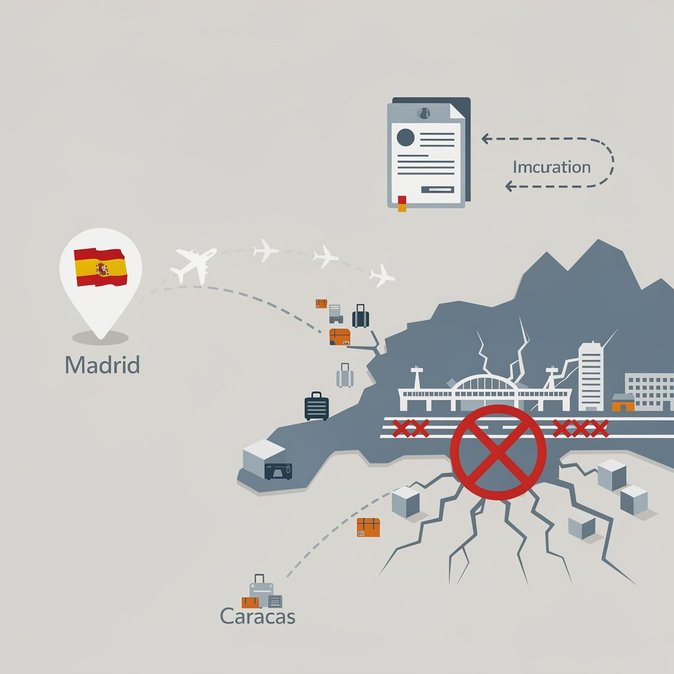
All three Spanish carriers serving Venezuela—Iberia, Air Europa and Plus Ultra—cancelled their Madrid–Caracas rotations on Thursday, 25 June, after a 6.8-magnitude earthquake damaged runways and fuel lines at Maiquetía-Simón Bolívar International Airport. Airport authorities in Venezuela suspended operations indefinitely while engineers assess structural cracks in the main runway and the control tower. Iberia confirmed that flight IB6673 due to depart Madrid-Barajas at 13:40 and the inbound IB6674 are cancelled. Air Europa grounded UX071/072, and long-haul specialist Plus Ultra scrapped its PU722/723 pair. The airlines are offering free date changes until 15 August, re-routing where possible via Bogotá or Santo Domingo, or full refunds. Spain’s Civil Aviation Authority (AESA) has reminded corporate travel managers that EU261 compensation does not apply because the closure is a force-majeure safety measure. Spain’s Consulate in Caracas issued an emergency alert urging the 187,000 registered Spanish nationals in Venezuela to “verify the whereabouts and condition of all relatives and colleagues” and to update contact details via the Registro de Matrícula. Companies with assignees in the country are advised to activate business-continuity plans and ensure that staff hold at least six months’ passport validity to facilitate evacuation through third-country hubs if the shutdown is prolonged. The suspension places additional pressure on freight capacity: the Madrid-Caracas route normally carries 35 tonnes of pharmaceuticals and automotive components per week. Logistics providers are exploring sea-air combinations via the Dominican Republic. Travel-risk consultancies warn that after-shocks could delay reopening for several weeks, disrupting summer expatriate rotations and humanitarian deployments linked to Spain’s extraordinary regularisation scheme. From an immigration perspective, the Venezuelan closure may slow the pipeline of Venezuelan nationals applying for Spain’s humanitarian and digital-nomad permits, as biometric appointments at the Madrid Consular Visa Hub require original entry stamps. Employers should factor extra lead-time into assignment start dates and monitor re-booking windows once operations resume.