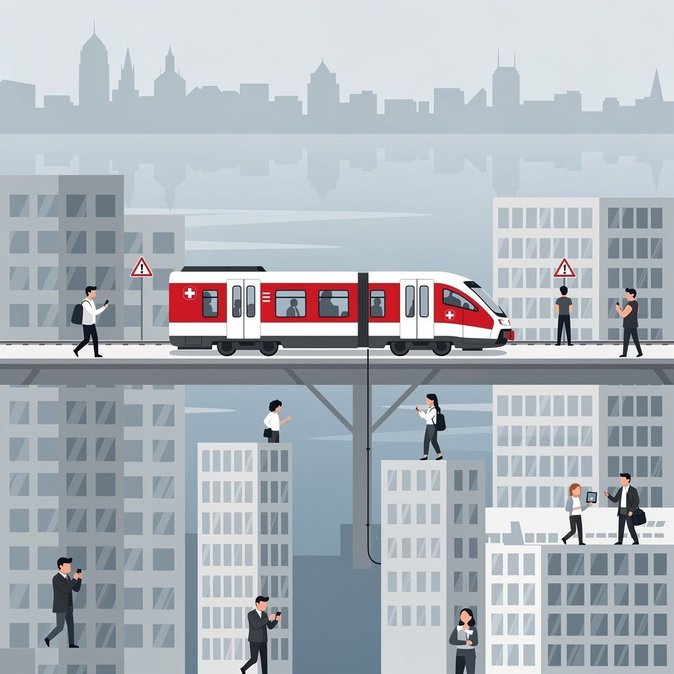
Commuters on Zurich’s busy right-bank corridor faced an unplanned stress test on Monday morning, 29 June 2026, when a stranded train blocked the twin-track section between Zürich Stadelhofen and Stettbach. Swiss Federal Railways (SBB) issued its first alert at 07:15, warning that services on the S3, S5, S9, S11, S12, S15 and S23 lines would be curtailed or diverted for at least 90 minutes. The incident effectively severed the direct rail artery between Zurich Hauptbahnhof (HB) and the fast-growing technology cluster around Uster during the peak inbound rush. Crowd-management teams redirected passengers to replacement buses and advised city-centre travellers to switch to tram route 12. The disruption eased shortly after 09:00, but residual delays persisted throughout the morning diagram. For global-mobility professionals the episode illustrates the fragility of last-mile links within Switzerland’s otherwise world-class public-transport network. Many expatriate employees live along Lake Zurich and rely on 7-minute interval S-Bahn services to reach corporate head offices and client sites downtown. Even a short blockage forces missed meetings, overtime costs and potential overtime surcharges for contractors paid on an hourly basis. SBB has invested CHF 500 million in digital signal technology on the right-bank line, yet capacity remains near saturation during peak windows. The railway reiterated its long-term plan to extend the Hirschengraben tunnel by 2031, which would create a second cross-city link and provide redundancy for incidents such as Monday’s blockage. Until then HR teams should continue to recommend flexible start times and remote-working contingencies for staff based on the corridor.
Source: Watson.ch