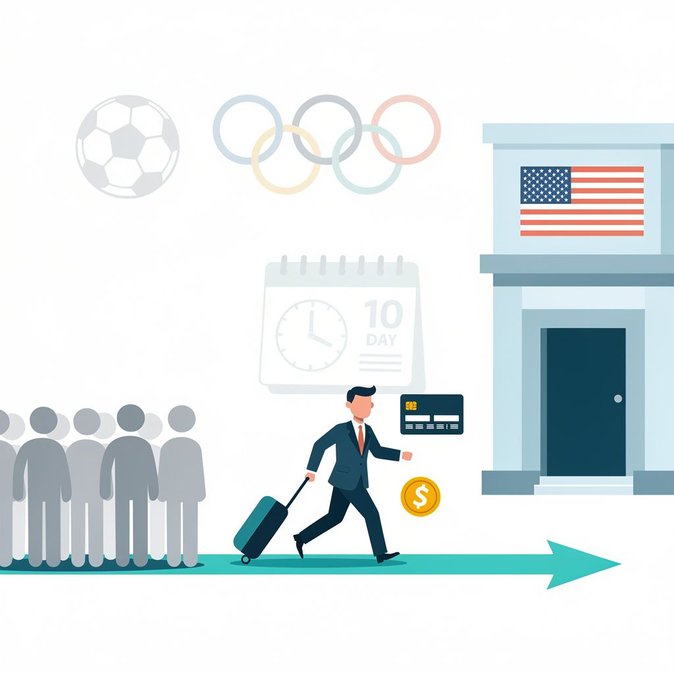
The U.S. Department of State’s long-anticipated pilot programme allowing visitors to pay a US$750 “Non-Immigrant Visa Appointment Expedite Fee” officially takes effect today, 1 July 2026.
For travelers weighing whether to use the pilot, VisaHQ’s online platform can simplify the process: the service walks applicants through eligibility questions, handles fee payments and monitors appointment availability at participating U.S. consulates. Learn more at https://www.visahq.com/united-states/
Under the six-month test, select U.S. embassies and consulates may offer B-1 (business) and B-2 (tourism) visa applicants an interview slot within 10 business days of payment, in addition to the regular US$185 MRV fee. Although the temporary final rule does not guarantee visa issuance or faster post-interview processing, it gives corporate travel managers a badly needed tool for truly last-minute trips. Median global wait times for B-class visas still hover around 30 days, and can stretch past a year in a handful of missions. The State Department says the pilot is designed to stress-test capacity ahead of mega-events such as the 2026 FIFA World Cup and the 2028 Los Angeles Olympics. Only posts that opt in—and have surplus interviewing capacity—can display the paid-expedite option in their online scheduling portals. Washington has not yet published the list of participating consulates; insiders expect large hubs such as Mumbai, São Paulo, London and Manila to appear first. Applicants who upgrade may also receive premium courier return of passports at no extra cost. For multinationals, the fee will be a trade-off between cost and business impact. A four-person sales team could add US$3,000 in fees to a trip budget, but avert the far greater losses of missing a client pitch. Immigration counsel caution that applicants who misuse B-1 status for productive work in the United States still risk refusal despite the premium slot. The State Department will collect data on demand, fraud indicators and overall wait-time effects, then decide by year-end whether to extend the paid fast-track or roll it out permanently.
For travelers weighing whether to use the pilot, VisaHQ’s online platform can simplify the process: the service walks applicants through eligibility questions, handles fee payments and monitors appointment availability at participating U.S. consulates. Learn more at https://www.visahq.com/united-states/
Under the six-month test, select U.S. embassies and consulates may offer B-1 (business) and B-2 (tourism) visa applicants an interview slot within 10 business days of payment, in addition to the regular US$185 MRV fee. Although the temporary final rule does not guarantee visa issuance or faster post-interview processing, it gives corporate travel managers a badly needed tool for truly last-minute trips. Median global wait times for B-class visas still hover around 30 days, and can stretch past a year in a handful of missions. The State Department says the pilot is designed to stress-test capacity ahead of mega-events such as the 2026 FIFA World Cup and the 2028 Los Angeles Olympics. Only posts that opt in—and have surplus interviewing capacity—can display the paid-expedite option in their online scheduling portals. Washington has not yet published the list of participating consulates; insiders expect large hubs such as Mumbai, São Paulo, London and Manila to appear first. Applicants who upgrade may also receive premium courier return of passports at no extra cost. For multinationals, the fee will be a trade-off between cost and business impact. A four-person sales team could add US$3,000 in fees to a trip budget, but avert the far greater losses of missing a client pitch. Immigration counsel caution that applicants who misuse B-1 status for productive work in the United States still risk refusal despite the premium slot. The State Department will collect data on demand, fraud indicators and overall wait-time effects, then decide by year-end whether to extend the paid fast-track or roll it out permanently.