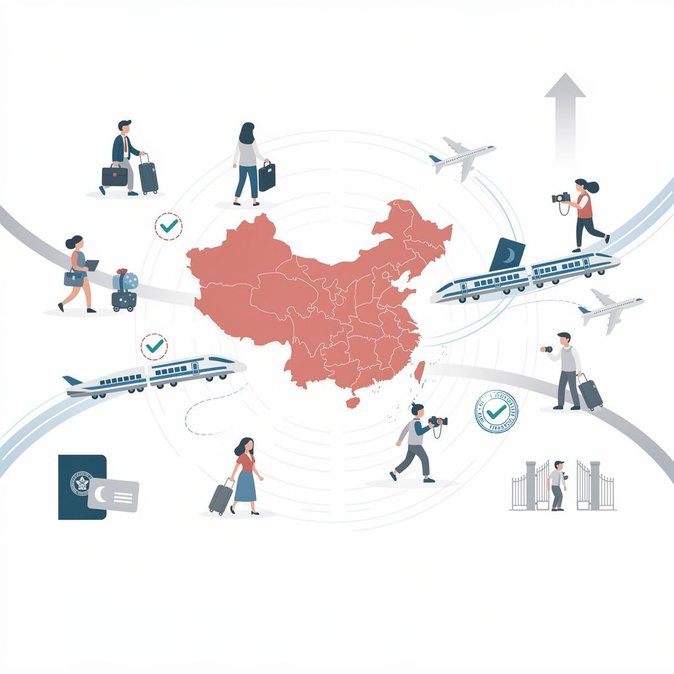
China’s National Immigration Administration (NIA) revealed on 10 July that its officers processed 369 million inbound and outbound trips in the first six months of 2026—a historic high and a 10.8 percent jump on the same period last year. Of that total, 45.9 million crossings were made by foreign nationals, up 20.6 percent year-on-year, while 17.8 million travellers entered the country under one of China’s rapidly-expanding visa-free or 24-/144-hour transit-visa exemption schemes. The figures underscore the rebound of international mobility into and out of China following three years of pandemic-related disruption.
Whether your employees are entering visa-free, applying for a work permit or transiting on tight deadlines, VisaHQ can streamline the process with online document checks, digital application filing and real-time status updates—saving mobility teams hours of administrative work. Explore our dedicated China services hub at to see how we can simplify both straightforward and complex travel scenarios.
Mainland residents accounted for 176 million trips, and travellers from Hong Kong, Macau and Taiwan made 147 million crossings—illustrating how the Greater Bay Area and cross-strait commercial ties continue to anchor regional business travel. Corporate mobility managers will welcome the news that visa-free arrivals now make up nearly 78 percent of all foreign entries. China unilaterally waives visas for citizens of 50 countries and operates a 240-hour visa-free transit programme at 65 ports of entry. For multinationals this translates into lower compliance costs, faster deployment of project teams and greater flexibility when routing regional itineraries through Chinese hubs such as Shanghai Pudong, Beijing Daxing and Guangzhou Baiyun. Behind the headline numbers, authorities stressed ongoing digitalisation: more than 250 million movements were processed through automated e-gates, reducing average border-clearance time for passport holders to under 20 seconds. The NIA also reiterated its commitment to rolling out electronic Border Management Area permits this year, which will allow authorised foreign workers to apply online for travel to China’s sensitive frontier zones—important for energy, mining and infrastructure projects. For employers, the record traffic reinforces two imperatives: secure flights and accommodation early for autumn trade-fair season, and review internal travel-risk policies. Although border queues are shortening, secondary screening remains robust for travellers with previous overstays or irregular work histories. Companies should make sure assignees carry print-outs of their invitation letters, proof of accommodation and, where relevant, evidence of tax compliance to avoid delays at immigration.

Whether your employees are entering visa-free, applying for a work permit or transiting on tight deadlines, VisaHQ can streamline the process with online document checks, digital application filing and real-time status updates—saving mobility teams hours of administrative work. Explore our dedicated China services hub at to see how we can simplify both straightforward and complex travel scenarios.
Mainland residents accounted for 176 million trips, and travellers from Hong Kong, Macau and Taiwan made 147 million crossings—illustrating how the Greater Bay Area and cross-strait commercial ties continue to anchor regional business travel. Corporate mobility managers will welcome the news that visa-free arrivals now make up nearly 78 percent of all foreign entries. China unilaterally waives visas for citizens of 50 countries and operates a 240-hour visa-free transit programme at 65 ports of entry. For multinationals this translates into lower compliance costs, faster deployment of project teams and greater flexibility when routing regional itineraries through Chinese hubs such as Shanghai Pudong, Beijing Daxing and Guangzhou Baiyun. Behind the headline numbers, authorities stressed ongoing digitalisation: more than 250 million movements were processed through automated e-gates, reducing average border-clearance time for passport holders to under 20 seconds. The NIA also reiterated its commitment to rolling out electronic Border Management Area permits this year, which will allow authorised foreign workers to apply online for travel to China’s sensitive frontier zones—important for energy, mining and infrastructure projects. For employers, the record traffic reinforces two imperatives: secure flights and accommodation early for autumn trade-fair season, and review internal travel-risk policies. Although border queues are shortening, secondary screening remains robust for travellers with previous overstays or irregular work histories. Companies should make sure assignees carry print-outs of their invitation letters, proof of accommodation and, where relevant, evidence of tax compliance to avoid delays at immigration.