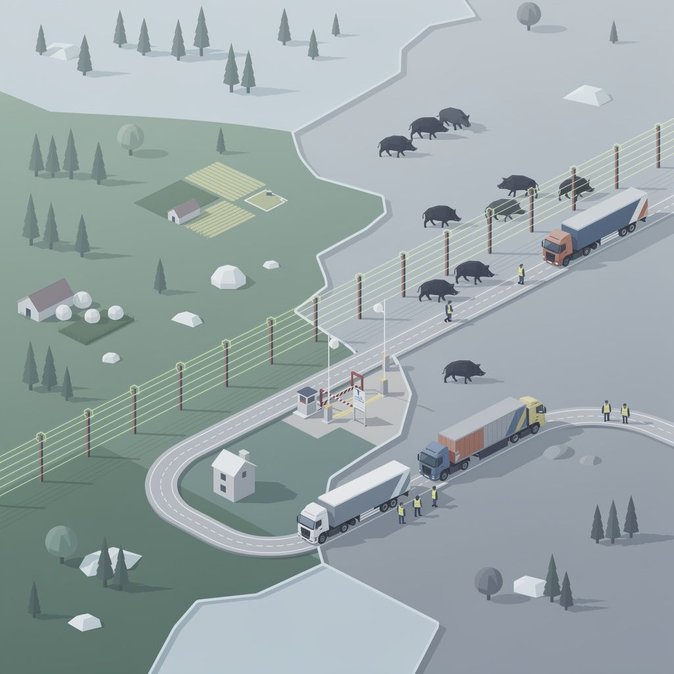
In an unusual bio-security project with cross-border implications, the Finnish Food Authority announced on 12 November that it will build an 83-kilometre electric fence in southeast Finland to contain an outbreak of African Swine Fever (ASF) among wild boar. The temporary barrier will trace the perimeter of an infection-zone spanning the municipalities of Miehikkälä, Virolahti and Lappeenranta, areas located less than 50 km from the Russian border. Construction is scheduled to begin in December and finish within three months, using a 1.2-metre-high, five-wire system proven effective in Central Europe. Gates will allow road traffic, but forestry tracks may be closed to prevent porcine movement. While ASF does not infect humans, an uncontrolled spread would devastate Finland’s €300-million pork industry and could trigger trade bans on live animals and meat exports. The decision follows the first confirmed ASF cases in Finnish wild boar earlier this year—likely introduced from Russia, where the virus is endemic. Because the EU internal market treats animal-health zones like customs frontiers, preventing spill-over is crucial to maintaining unrestricted agri-food trade within the bloc. The Agriculture Ministry is briefing transport operators that any pigs or pig products moving out of southeast Finland will require additional veterinary certification until further notice. For logistics firms specialising in temperature-controlled cargo, the fence may alter truck routings and bio-security checkpoints. Employers sending expatriate staff to border-area farms or food-processing plants must ensure strict hygiene protocols, including mandatory boot disinfection and vehicle cleaning when crossing the zone. Airlines flying live-animal consignments from Helsinki Airport can continue operations, but carriers must verify that origin farms are outside restricted areas. Although primarily an animal-health measure, the fence underscores how disease outbreaks can rapidly translate into de facto mobility controls, reinforcing Finland’s broader push to harden its eastern border infrastructure.
Source: Yle News