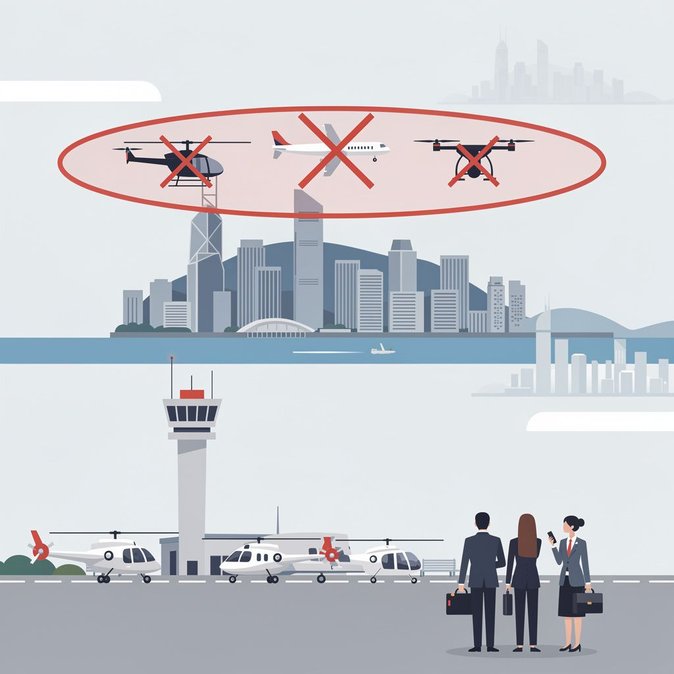
Hong Kong’s Civil Aviation Department (CAD) has issued an Aeronautical Information Publication (AIP) supplement that will effectively close the territory’s airspace to all civilian helicopters and other light aircraft from 00:01 on Tuesday 17 November until 23:59 on Friday 20 November. The four-day blanket ban coincides with the Asia-Pacific Economic Cooperation (APEC) Economic Leaders’ Week being hosted just across the border in Shenzhen. Under the rules, only the Government Flying Service—which performs emergency medical, police and search-and-rescue missions—will be exempt. Operators of sightseeing flights, cross-boundary helicopter charters to Macau and Shenzhen, aerial photography companies and flight-training schools have already begun notifying customers and rescheduling sorties. Passengers booked during the blackout window are being offered refunds or alternative dates. The CAD notice also designates a separate restricted zone in Hong Kong’s northern New Territories in which drones, paragliders, kites and captive balloons will be prohibited unless special approval is obtained. Violations carry penalties of up to two years’ imprisonment and a HK$100,000 (US$12,800) fine. Business-aviation planners say the move is unprecedented in scope for Hong Kong. Fixed-wing jet operations at Hong Kong International Airport (HKG) are not directly affected, yet operators are bracing for short-notice slot changes and increased air-traffic flow restrictions as mainland China enforces a 200-km security ring around Shenzhen. Corporates moving executives during the APEC period are advised to confirm ground-handling arrangements early, build longer connection buffers and keep contingency plans for regional rotor-wing transfers via Macau or Zhuhai once restrictions lift. For mobility managers, the episode is a reminder that regional political events can trigger sudden airspace closures that upend itineraries. Companies with critical travel to or from Hong Kong between 17 and 20 November should monitor CAD NOTAMs, stay in close contact with charter brokers and alert travellers through internal risk-management channels.
Source: Hong Kong News TV