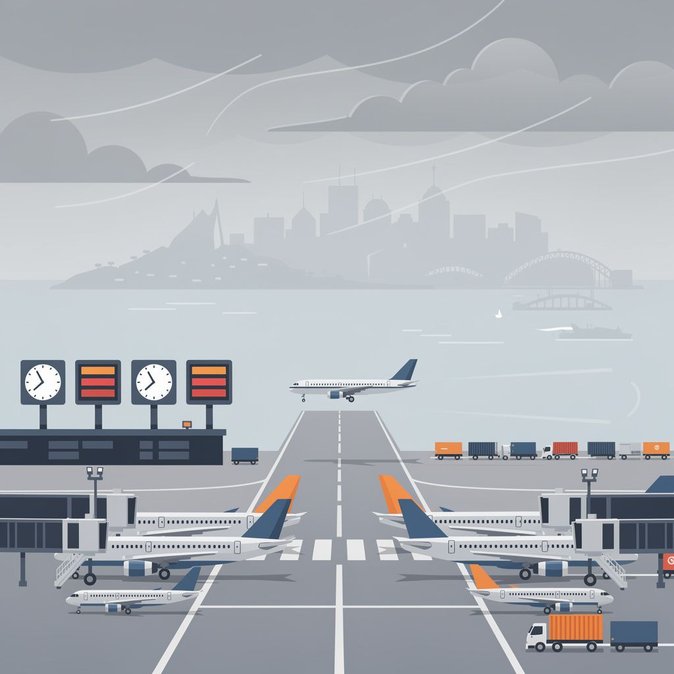
Severe weather once again tested the resilience of Australia’s busiest gateway Monday night, when air-traffic controllers restricted Sydney (Kingsford Smith) Airport to single-runway operations because of low cloud and gusting winds. The order, in place for much of the afternoon peak, capped arrivals at 28 per hour—well below normal capacity—and forced airlines to cancel 104 domestic services, mainly to Melbourne, Brisbane and Gold Coast. Footage captured by Reuters showed aircraft executing go-arounds in heavy drizzle as ground staff struggled with waterlogged aprons. Virgin Australia warned of “knock-on delays” through mid-week as crews and aircraft reposition, while Qantas and Jetstar offered fee-free rebooking or refunds. With Sydney operating at near-slot-coordinated levels since borders reopened, even modest weather events now cascade across the domestic network. Monday’s disruption stranded hundreds of business travellers ahead of Tuesday morning meetings; some opted to switch to overnight trains or videoconferencing. Freight forwarders reported missed connections for high-value perishables and e-commerce parcels destined for regional centres. The incident also reignited debate over Sydney’s long-delayed third runway and the upcoming opening of Western Sydney International (WSI) in late 2026. Advocacy group Airlines for Australia & New Zealand said the cancellation tally “underlines the urgency of alternative capacity”, while the Transport Workers’ Union argued that chronic staffing shortages in air-traffic control magnify weather-related bottlenecks. From a mobility-management perspective the takeaway is contingency planning. Corporations are urged to build longer buffers into east-coast itineraries during the storm season and maintain traveller-tracking tools that flag missed onward international connections. Travel-risk teams should also check that duty-of-care providers can arrange ground transport and last-minute accommodation when disruptions spike.
Source: ABC News / Reuters composite