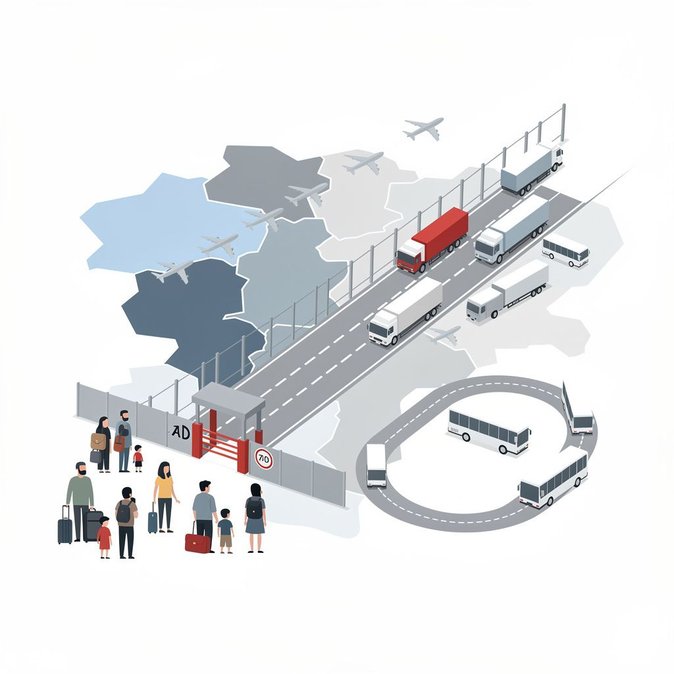
The Polish Council of Ministers has formally prolonged the temporary ban on submitting asylum applications at official crossings along the Polish-Belarusian frontier for another 60 days, effective 17 November 2026. The extension – the tenth since the measure was first introduced in March 2025 – was published in the Journal of Laws on 16 November and entered into force the following morning. The government argues that Minsk continues to facilitate irregular migration as a form of hybrid pressure on the EU, citing recurring incidents in which groups of migrants throw stones, branches and improvised weapons at Polish patrols. Under the ordinance, Border Guard officers must refuse to accept protection claims from most people intercepted on or near the green border. Exemptions exist for unaccompanied minors, pregnant women and other vulnerable individuals, as well as for anyone who can demonstrate an imminent risk of serious harm in their country of origin. The latest parliamentary justification stresses that Belarusian security forces themselves have “targeted Polish personnel with lasers and small-arms threats”, reinforcing Warsaw’s view that the situation still meets the Schengen Code’s threshold for emergency measures. For employers and mobility managers the extension prolongs operational uncertainty around the Kuźnica, Bobrowniki and Połowce road crossings, which remain open only for freight traffic. Passenger coaches must continue to detour via Lithuania, adding up to four hours to road journeys between Warsaw and Vilnius. Companies moving machinery or project staff between Poland and Belarus must also factor in ad-hoc security inspections and convoy requirements introduced last year. Human-rights NGOs have condemned the move, warning that repeated renewals risk turning a temporary derogation into a quasi-permanent policy. The Polish business community, however, largely supports the measure, arguing that it prevents sudden surges in irregular entries that could overwhelm local housing and social services in the Podlaskie and Lubelskie regions. Legal advisers are reminding multinationals that the restrictions do not apply at Poland’s airports; Belarusian employees with valid Schengen visas may still fly into Warsaw or Kraków if they meet normal entry conditions.
Source: Wirtualna Polska (wp.pl)