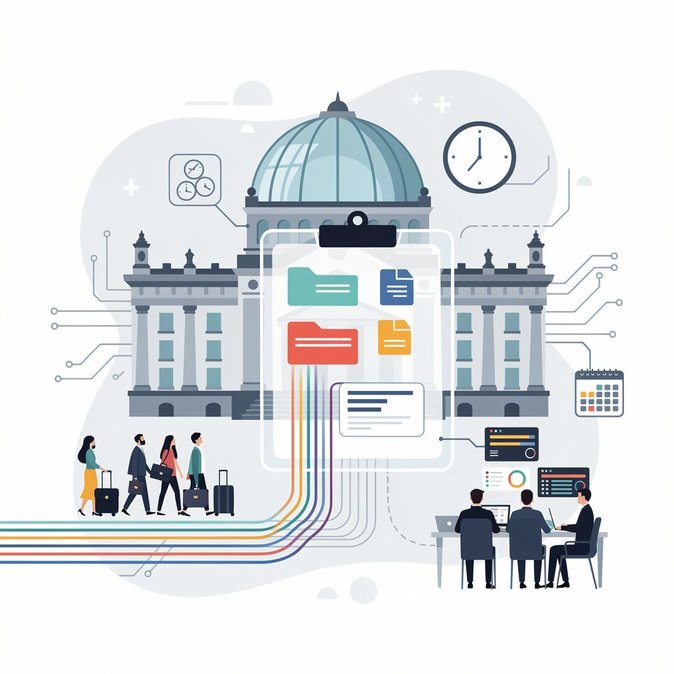
Germany’s push to digitalise migration management will reach a milestone next week when the Bundestag’s Interior Committee holds a public hearing on the government’s draft “KI-Migrationsverwaltungsgesetz” (KIMVG). The session, officially announced on 18 November, will be livestreamed from the Paul-Löbe-Haus in Berlin. The bill mandates the Federal Office for Migration and Refugees (BAMF) to deploy AI-based triage tools that sort and pre-check visa, asylum and residence-permit applications. It also proposes an interoperable data-layer linking Ausländerbehörden, consulates and labour-market authorities, while introducing algorithmic-accountability clauses modelled on the EU AI Act. For employers, the headline feature is a “once-only” principle: documents such as degree recognition or salary statements submitted for an EU Blue Card could be reused across subsequent applications, cutting duplicate paperwork. The draft also sets statutory deadlines – 30 days for skilled-worker visas and 45 days for ICT permits – and imposes automatic approval if authorities miss them. Privacy advocates on the witness list, including the Gesellschaft für Freiheitsrechte, warn of bias risks in predictive-fraud scoring. Industry groups such as the Mechanical Engineering Association (VDMA) support the bill but demand clear service-level agreements to ensure the new systems do not cause downtime during the 2027 rollout. If enacted in its current form, KIMVG could make Germany one of the first EU members with legally binding AI standards in migration services – a development that would directly affect relocation timelines and compliance strategies for multinational HR teams.