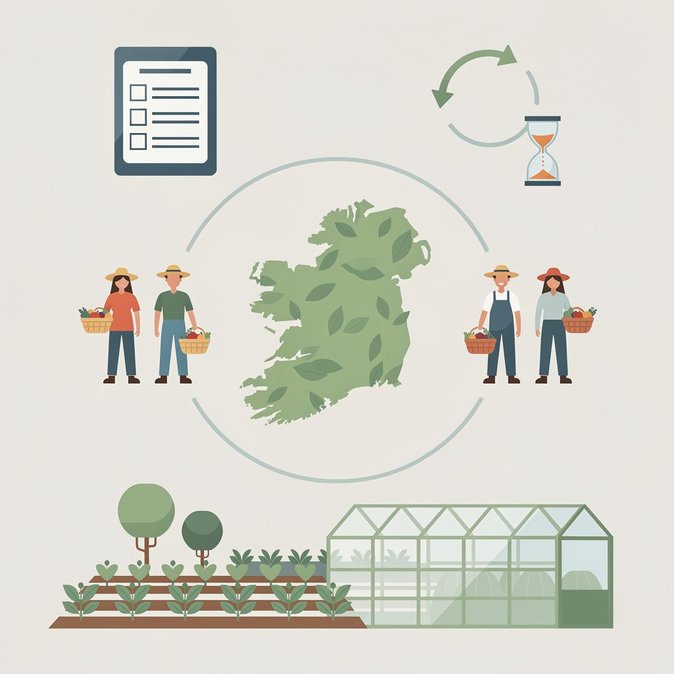
Ireland has taken the wraps off its first Seasonal Employment Permit (SEP) programme, publishing detailed guidance late last night. The pilot caps approvals at just 300 permits for the entire 2027 picking season and limits participation to six pre-approved horticulture employers. Worker applications will open on 1 January 2027, but only after those employers secure “Approved Seasonal Employer” status by the 12 December 2026 deadline. According to the Department of Enterprise, Trade and Employment, the new route is designed to plug acute labour gaps on Irish fruit and vegetable farms without creating a permanent migration channel. Permits will run for three to seven months, pay a pro-rated minimum of €32,691 per annum, and require employers to provide both accommodation and private health insurance. The pilot also tests a pared-back application fee—waived entirely—to keep costs competitive with rival EU agri-work schemes in Spain and Portugal. Crucially, recruitment will be confined to nationals of two unnamed partner countries that have bilateral agreements with Ireland. Government sources indicate negotiations are at an advanced stage with Georgia and the Philippines, mirroring partner selections in comparable EU schemes. Employers must still complete the Labour Market Needs Test and meet Ireland’s 50:50 resident-worker ratio, ensuring at least half the workforce remains EU/UK/Swiss. For global-mobility teams, the SEP adds a short-term staffing option that sits outside the main employment-permit quota system. Multinationals running agri-processing operations can use the programme to cover harvest peaks without locking in long-term headcount. However, the tiny quota means competition will be fierce; advisers are already urging clients to finalise documentation now, ahead of the holiday lull. The department has pledged a post-season review next autumn. If the pilot proves manageable for immigration authorities and labour inspectors, officials say a larger, multi-sector seasonal scheme could follow in 2028, bringing Ireland closer to EU peers that already issue tens of thousands of seasonal permits each year.
Source: Europe Observer