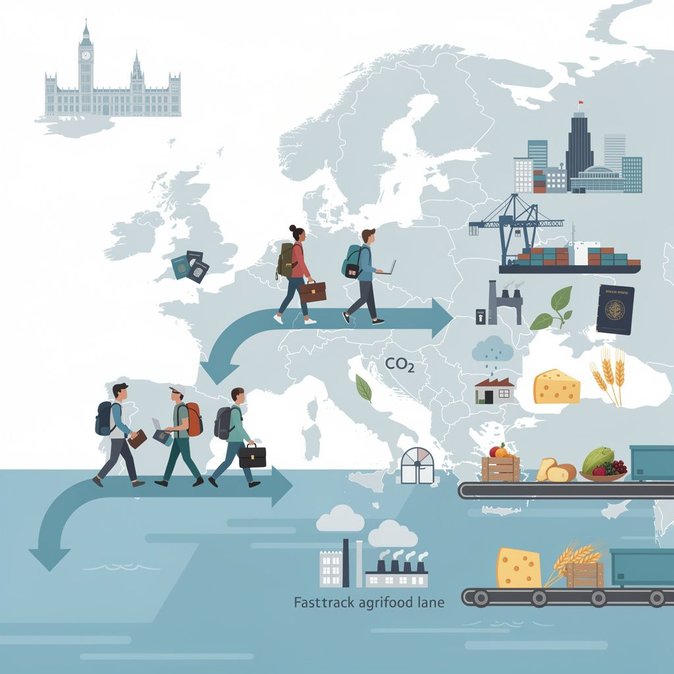
Less than 24 hours before EU leaders welcome U.K. Prime Minister Andy Burnham to the Berlaymont, details are emerging of the Brussels summit’s mobility agenda. According to EU and British officials quoted by the Associated Press on 18 November, the two sides will sign: • A youth mobility accord allowing citizens aged 18-30 to live and work in each other’s territory for up to two years, with streamlined visa sponsorship handled by employers; • A mutual recognition arrangement on emissions-trading permits, reducing compliance checks for companies that shift assignments across the Channel; and • A fast-track sanitary-and-phytosanitary (SPS) lane for agrifood products, expected to cut customs clearance times at Zeebrugge and other Belgian ports. For Belgium, which processes roughly 16 % of U.K.–EU trade volumes, the package could translate into smoother flows through Antwerp-Bruges and more predictable work-permit processing by the Flemish and Walloon regional authorities. HR teams may soon have an alternative to the U.K.’s £298 skilled-worker visa and Belgium’s Single Permit when rotating graduates and trainees. The youth scheme will initially be capped at 20,000 participants per side and require proof of financial means but no labour-market test. EU officials say it could serve as a template for similar pacts with other former Member States. Immigration lawyers caution that the agreement still needs ratification by the European Parliament and the Belgian federal parliament before taking effect, likely in mid-2027. Strategically, the summit signals a thaw in relations ten years after Brexit. By focusing on mobility, climate and food safety — areas with immediate benefits for citizens and businesses — negotiators hope to build trust for deeper talks on customs and financial services. Belgium’s government, hosting the meeting, has touted the deals as proof that “pragmatic cooperation beats ideological red lines”.
Source: Associated Press