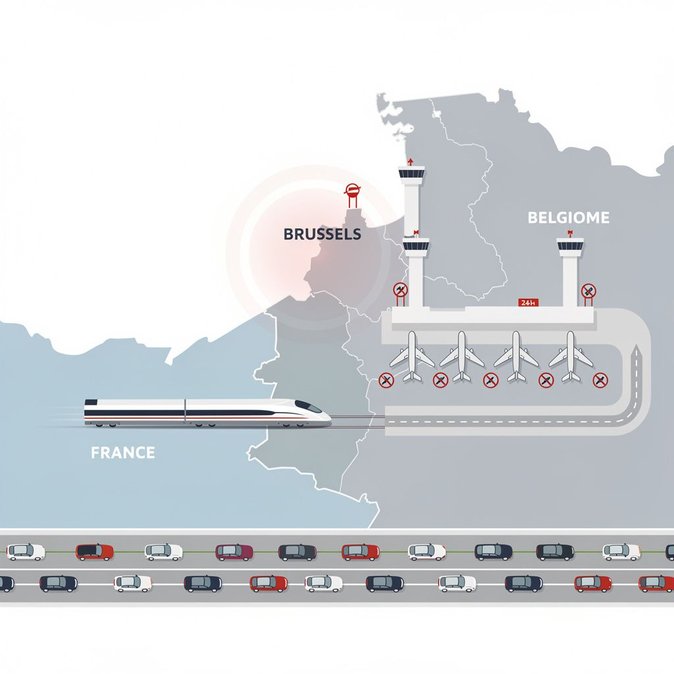
French executives and mobility managers woke up on Monday, 23 November 2026 to alerts that all commercial flights at Brussels-Zaventem and Brussels South Charleroi were cancelled between 07:00 and 21:00 as Belgium’s three main trade-union confederations staged a nationwide day of protest. The walk-out included air-traffic-control staff at skeyes, forcing a complete shutdown of Belgian airspace for most of the business day. The Brussels Airport operator urged passengers not to come to the airport unless their airline had rebooked them and warned that evening departures could also be at risk if crews breached maximum duty times. France felt the impact almost immediately. Air France and several low-cost carriers operate up to 14 daily rotations between Paris and Brussels, and Thalys had already reported near-full trains due to travellers switching to rail once the strike notice was confirmed. French logistics firms moving time-critical freight by air were forced to truck consignments to Lille, Paris-Charles-de-Gaulle or Luxembourg to catch connecting flights. Mobility teams at CAC 40 multinationals circulated contingency plans reminding staff that EU261 compensation does not apply when cancellations are caused by air-traffic-control strikes. The strike also hit road mobility: Belgium’s STIB and De Lijn bus and metro networks ran skeleton services, creating traffic jams on the E19 and A2 motorways towards the Franco-Belgian border. French companies with commuters living in Belgium were advised to invoke remote-working clauses or staggered hours. SNCF confirmed that TGV Inoui and Ouigo trains between Paris-Nord and Brussels-Midi were still running, but warned of possible station bottlenecks because only two Brussels metro lines were operating. Although one-day strikes in Belgium are not uncommon, an all-day closure of national airspace is rare and underscores the interdependence of the two neighbours’ business ecosystems: the Île-de-France region is Brussels Airport’s second-largest catchment area after Flanders. Travel-management companies said the episode highlights the need for French businesses to build multimodal resilience into mobility policies—booking flexible rail fares, pre-clearing electronic travel authorisations for company drivers, and maintaining overnight allowances for unexpected stays. Looking ahead, unions hinted at further action if the Belgian government does not revisit its 2027 budget. French mobility professionals should therefore monitor strike trackers and set up automated traveller-location alerts. For now, flights are expected to resume from 21:00, but airlines warned that schedules on 24 November could still be disrupted as aircraft and crews reposition.