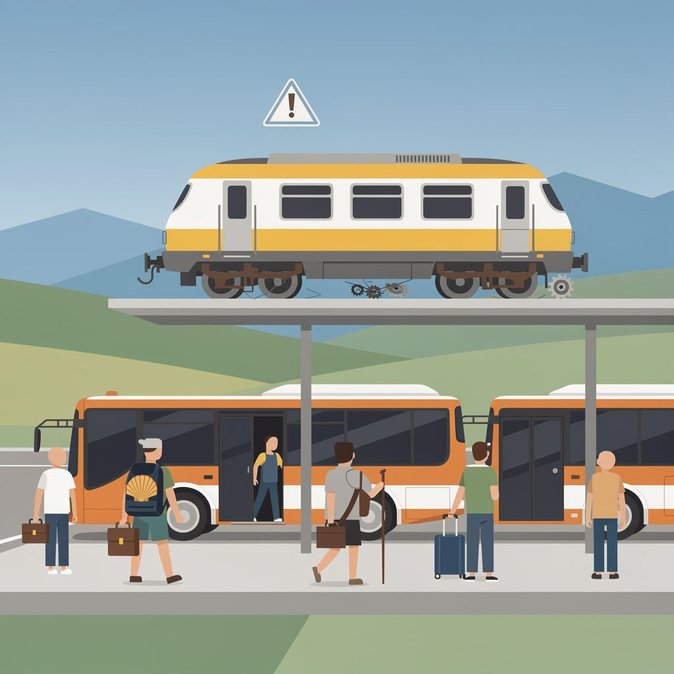
Spain’s state operator Renfe cancelled every medium-distance train between León and Ponferrada on 25 November after multiple diesel units broke down overnight. The company is bussing passengers but warns that repairs to the 30-year-old 470-series fleet could take several days, also threatening services toward Palencia and Sahagún. Renfe insiders told Cadena SER that chronic under-investment in non-electrified rolling stock has left the north-western corridor with just three operable sets, two of which suffered engine failures on Tuesday. The outage disrupts commuters linking with Madrid-bound AVE services and pilgrims traversing the Camino de Santiago, forcing luggage-heavy travellers onto slower mountain roads. The incident highlights broader infrastructure asymmetry: while Spain boasts Europe’s largest high-speed network, ageing conventional lines still carry 45 % of domestic passengers but receive only 18 % of rolling-stock CAPEX, according to transport-ministry figures. Business-travel managers should flag potential knock-on delays for employees connecting through León hub, consider rerouting via Oviedo or A Coruña, and confirm that rail-inclusive corporate insurance covers bus substitutions. For global-mobility teams relocating staff to Castilla y León, the episode underscores logistical vulnerabilities—reduced service frequency, limited onboard workspace, and higher car-rental dependence—that can affect assignment budgets and quality of life. Stakeholders await the ministry’s long-promised tender for hybrid multiple units capable of both diesel and 25 kV operation on partially electrified routes.
Source: Cadena SER