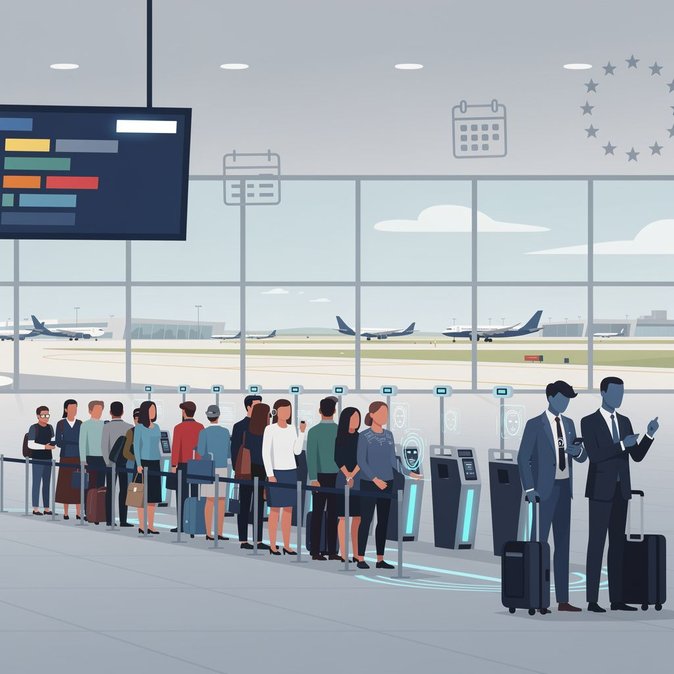
A coalition of 70 European travel and tourism bodies, led by ACI Europe, on 26 November called on the European Commission to renew the waiver that allows Member States to suspend mandatory biometric capture under the new Entry/Exit System (EES) when queues exceed safe limits. The industry manifesto cites “persistent implementation issues” and warns that airports such as Rome-Fiumicino and Milan-Malpensa risk reputational damage if first-time biometric enrolment continues to push non-EU arrival processing times beyond 45 minutes. Italy formally completed its EES roll-out in April 2026 but, like France, Germany and six other countries, has quietly operated so-called ‘flex-mode’ during peak periods. That derogation expires on 31 December. According to ACI Europe’s survey, 63 percent of Italian travellers accepted some delay for security reasons, yet more than half said tolerance dropped sharply when waits topped 30 minutes. For global-mobility managers, the uncertainty means assignees making their first Schengen entry in Q1 2027 could face unpredictable processing times. Advisers recommend scheduling at least a three-hour buffer between landing and onward rail or domestic flights and encouraging staff to use airports that offer pre-registration kiosks. Carriers are updating minimum connection times, and some, including ITA Airways, report load-factor impacts on high-yield routes from the United States and the Gulf. ACI Europe’s secretary general, Olivier Jankovec, warned that without a renewed flexibility clause, tourism-dependent economies such as Italy, Spain and Greece could “see recovery stall just as long-haul demand is returning”. The Commission is expected to respond before the year-end; insiders say Brussels may allow a country-by-country grace period tied to throughput benchmarks. Should the waiver lapse, Italian border police will have little discretion and must take four fingerprints and a live facial image from every third-country national the first time they enter. Companies may therefore wish to brief travellers and clients on likely delays and consider purchasing fast-track or VIP arrival services where available.
Source: ACI Europe / Tourism Manifesto