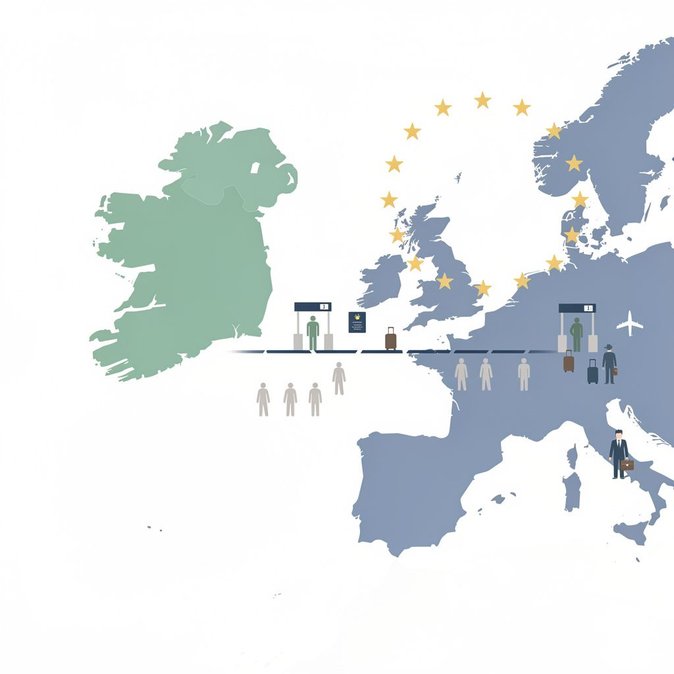
Ireland’s Department of Justice has been warned that the State risks becoming a “weak point” in the European Union’s new return-regulation package because it is outside the passport-free Schengen Area. The return regulation, adopted by EU interior ministers last month, will allow any member state to issue a deportation order that is automatically recognised by all other members, closing a long-criticised loophole that let refused asylum seekers lodge repeat applications in different jurisdictions. Internal briefings seen by The Irish Times show that Irish diplomats in Brussels support the tougher rules but fear Ireland cannot opt-in unless it also signs up to several underlying Schengen measures on border management and data-sharing. Officials told Brussels counterparts that, if Ireland remains out of the scheme, it could become an entry point for those seeking to evade the new system, potentially forcing the State to re-introduce controls on the land border with Northern Ireland—something Dublin is politically determined to avoid. Justice Minister Jim O’Callaghan has said he is “in principle” willing to join the return regulation and even to participate in controversial offshore “deportation hubs” being piloted by Germany, the Netherlands and others in Rwanda. Any opt-in, however, must be squared with the Common Travel Area (CTA) that guarantees seamless movement between Ireland and the United Kingdom; London is not part of Schengen and is rolling out its own Electronic Travel Authorisation (ETA) regime. For multinationals moving staff in and out of Ireland, the debate matters because the country’s relative openness has been a selling point when selecting EU hubs. If policy mis-alignment forces new checks on the Irish-UK border or adds layers of compliance for short-term assignees, mobility programmes could face extra cost and complexity. Companies are therefore lobbying the Department of Justice to secure associate participation in the EU scheme without triggering land-border controls, possibly by adopting Schengen return-rules selectively while relying on CTA guarantees for intra-island travel. While no timeline has been set, officials said Dublin must decide “within months” whether to join, as the return regulation enters force across Schengen states in mid-2027. HR and global mobility teams should monitor the negotiations closely and review removal-risk assessments for assignees who may have exhausted protection procedures elsewhere in the EU.
Source: The Irish Times