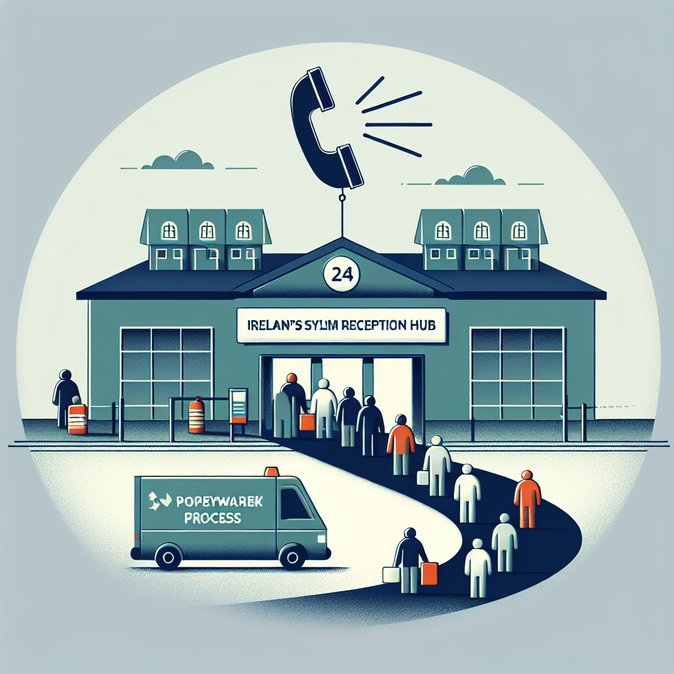
Dublin’s Citywest transit hub, the Republic’s main reception centre for new asylum applicants, has been closed to fresh arrivals from 23 December until 2 January to ease chronic overcrowding. Designed for 380 people, the complex has routinely hosted more than 700. To avoid leaving newcomers stranded in winter conditions, the Department for Children, Equality, Disability, Integration & Youth (DCEDIY) activated a 24-hour hotline on 30 December. Call-centre agents triage arrivals, allocate emergency beds or, when capacity is exhausted, issue hotel or hostel vouchers under a contingency plan.
Separate transport and reception arrangements have been organised for Ukrainian refugees arriving between 23–27 December and 1–2 January, reflecting the distinct legal pathway under the EU Temporary Protection Directive. NGOs welcomed the hotline but warned of ‘no-bed’ scenarios twice in the past month and called for faster move-on to modular housing.
![Citywest Transit Hub Closure Forces Hotline as Ireland Manages Holiday Asylum Surge]()
For employers, the temporary shutdown has ripple effects. Work-permit holders expecting family reunification may face processing delays if relatives cannot secure an accommodation address quickly. HR teams have been asked to confirm that any transferees landing during the blackout carry verifiable hotel reservations and to circulate the hotline number.
The episode underscores Ireland’s broader accommodation crunch, which increasingly intersects with labour-market mobility. With record permit approvals expected in tech, pharma and construction for 2026, analysts warn that housing bottlenecks could become a hidden barrier to talent attraction unless reception capacity scales in parallel.
DCEDIY says Citywest will reopen on 3 January with a lower occupancy ceiling and an online time-slot system to smooth arrivals, but capacity constraints are likely to persist through Q1 2026. Mobility managers should therefore build extra lead-time into relocation timelines and explore private-sector housing partnerships to secure bed-spaces ahead of visa-grant dates.
Separate transport and reception arrangements have been organised for Ukrainian refugees arriving between 23–27 December and 1–2 January, reflecting the distinct legal pathway under the EU Temporary Protection Directive. NGOs welcomed the hotline but warned of ‘no-bed’ scenarios twice in the past month and called for faster move-on to modular housing.

For employers, the temporary shutdown has ripple effects. Work-permit holders expecting family reunification may face processing delays if relatives cannot secure an accommodation address quickly. HR teams have been asked to confirm that any transferees landing during the blackout carry verifiable hotel reservations and to circulate the hotline number.
The episode underscores Ireland’s broader accommodation crunch, which increasingly intersects with labour-market mobility. With record permit approvals expected in tech, pharma and construction for 2026, analysts warn that housing bottlenecks could become a hidden barrier to talent attraction unless reception capacity scales in parallel.
DCEDIY says Citywest will reopen on 3 January with a lower occupancy ceiling and an online time-slot system to smooth arrivals, but capacity constraints are likely to persist through Q1 2026. Mobility managers should therefore build extra lead-time into relocation timelines and explore private-sector housing partnerships to secure bed-spaces ahead of visa-grant dates.
Source: VisaHQ Global Mobility News