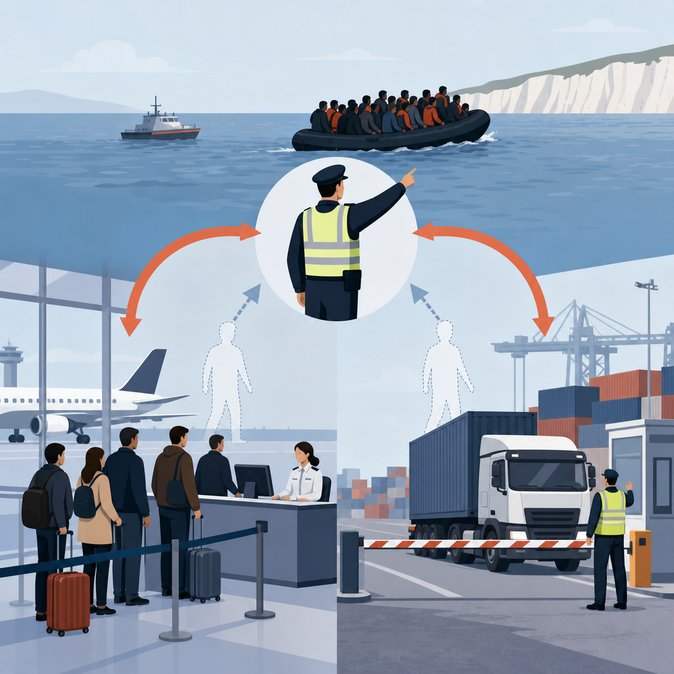
At RAF Northolt in west London, Prime Minister Sir Keir Starmer and Polish counterpart Donald Tusk signed the Northolt Treaty on 27 May—an accord billed as a “generational uplift” in bilateral security ties that also includes robust commitments to tackle irregular migration and organised crime. The treaty provides a legal framework for joint operations against people-smuggling networks operating along Europe’s eastern flank and commits both countries to share biometric and travel-history data in real time. A new UK-Poland Migration Taskforce will coordinate intelligence on forged documents and fast-track extradition of facilitators. Officials said the provisions mirror elements of the 2025 Lancaster House Treaty with France but go further by integrating cyber-forensics capacities developed in Warsaw after last year’s hybrid-attack incidents on Polish rail infrastructure. For global mobility professionals the practical effect is two-fold. First, Polish nationals representing one of the UK’s largest diaspora communities may benefit from streamlined “trusted-traveller” lanes due to go live at Heathrow and Warsaw Chopin airports in late 2027. Second, employers transferring staff between the two countries will face new due-diligence requirements: the treaty obliges companies moving defence-related goods or dual-use technology to file pre-departure passenger manifests with both border agencies at least 24 hours before travel. From a strategic perspective, London views the pact as part of a broader effort to reinforce Europe’s eastern border following Russia’s renewed offensive in Ukraine. Industry groups welcomed the clarity it brings—particularly defence contractors operating joint UK-Polish supply chains—but cautioned that the data-sharing elements will require systems upgrades to remain GDPR-compliant. The treaty will be laid before Parliament in June and is expected to enter into force in early 2027 once enabling legislation on information governance is passed.
Source: GOV.UK – Prime Minister’s Office