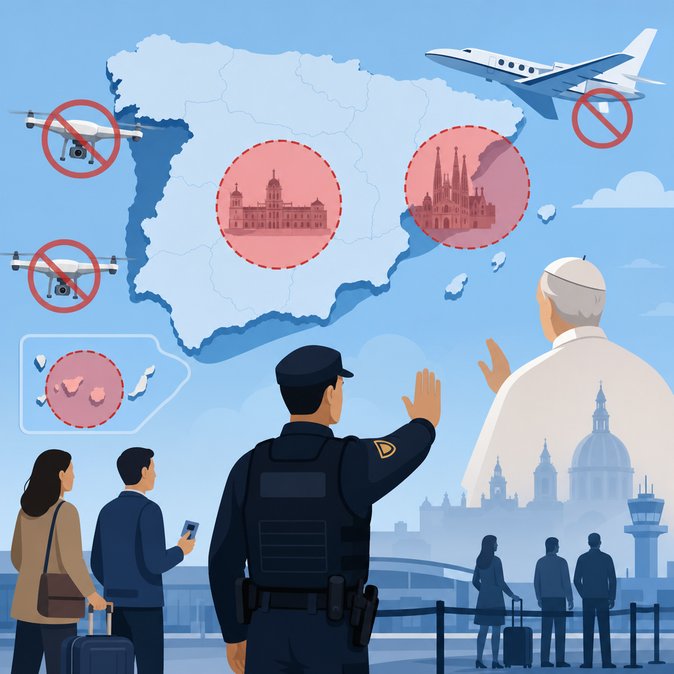
Spain’s National Police has unveiled an unprecedented Air-Space Security Device that will blanket Madrid, Barcelona and the Canary Islands in the run-up to Pope Leo XIV’s 6–12 June apostolic tour. Speaking in Madrid on 3 June, the force’s Aviation Unit confirmed that temporary flight-restriction zones (TFRs) will be activated around all papal venues and transfer routes, prohibiting the take-off, landing or over-flight of any crewed or uncrewed aircraft without explicit clearance from Spain’s aviation authority AESA. Commercial airlines will not be grounded, but they will be required to file alternative routings and be prepared for short-notice slot changes, while helicopter sightseeing operators and aerial work companies face complete suspension during key windows. The most visible change for the public is a blanket ban on amateur and professional drone activity within a 10-nautical-mile radius of the papal agenda, backed by mobile radio-frequency jammers, counter-UAS guns and a rapid-deployment drone-catching net system. Operators found in breach risk fines of up to €225,000 and potential criminal charges for “serious disobedience”. The National Police will coordinate real-time air-picture sharing with ENAIRE (Spain’s air-navigation service provider), military radar stations and the Mossos d’Esquadra and Ertzaintza air units to ensure seamless surveillance as the pontiff moves between Madrid, Barcelona and a brief stop-over in Tenerife on 11 June. Corporate aviation and business-jet operators flying delegations to papal events have been urged to request slots at least 48 hours in advance and to plan for ground-holding patterns at Málaga or Zaragoza in case of congestion at Madrid-Barajas or Barcelona-El Prat. Ground-handling firms told Global Mobility News that they have doubled staffing for the period and that fast-track immigration lanes will operate only for accredited VIPs; all other passengers must clear standard Schengen entry checks. From a mobility-programme standpoint, multinationals with expatriates or commuters in the three host regions should brief staff on likely last-minute road closures, potential helicopter shuttle cancellations and stricter ID screening at rail hubs. The Ministry of the Interior is also advising logistics companies to avoid night-time heavy-goods convoys on the A-2 and A-6 corridors on 5–6 June, when military convoys will escort papal vehicles. The air-security clamp-down is the most extensive deployed in Spain since the NATO Madrid Summit of 2022 and is seen as a rehearsal for the EU-wide drone rules that will accompany the full rollout of the Union’s U-space framework in October 2026. For travel-risk managers, the takeaway is clear: factor in extra lead times, keep passengers reachable by phone for rerouting, and remind any staff hobbyists that a holiday drone shot of the papamóvil could end in confiscation—or worse.
Source: Ministerio del Interior (Spain)
How VisaHQ can help
VisaHQ simplifies the visa application process for individuals and businesses. Check current travel requirements, prepare the required documents and manage your application online through the VisaHQ Spain portal.More From Spain
View all
Brussels tells France and Germany to lift long-running Schengen border checks—good news for Spanish cross-border trade

Spanish Ombudsman urges police to halt expulsions during 2026 mass-regularisation window