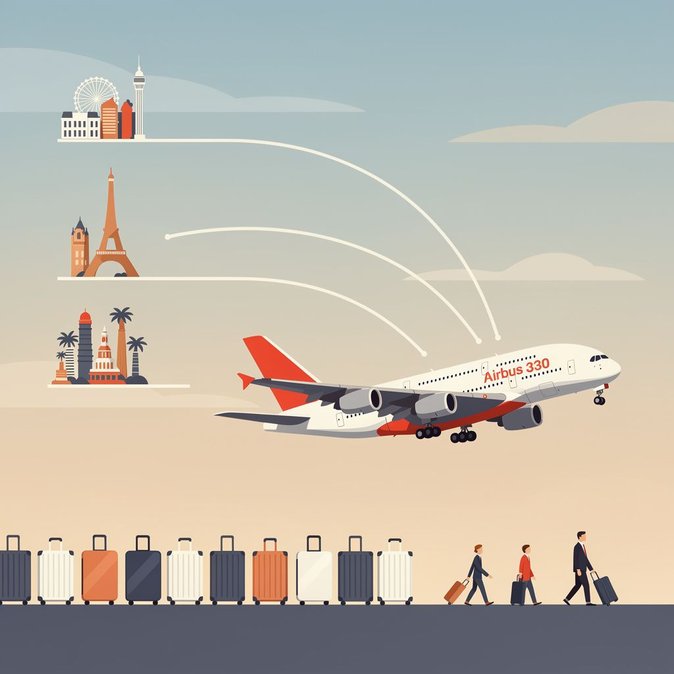
Emirates has unveiled an aggressive summer deployment plan that will see its flagship Airbus A380 operate 2,139 scheduled services next month—an average of 69 super-jumbo departures every day from Dubai International Airport. Internal scheduling data published by industry tracker Simple Flying and reported by UAE daily Al-Khaleej show that the double-deck jet will touch 48 destinations across six continents, underscoring the carrier’s confidence in demand despite lingering geopolitical headwinds in the Gulf. The July roster marks the full restoration—and, on several trunk routes, an expansion—of pre-war A380 frequencies. London again tops the table with five daily Heathrow rotations plus a daily Gatwick flight, followed by Paris Charles de Gaulle with three daily services. Emirates is also reinstating A380s to Copenhagen, Munich, Manchester and London Gatwick after a period of gauge downgrades earlier this year, signalling healthier forward bookings from corporate and VFR (visiting-friends-and-relatives) segments. Beyond Europe, the Dubai flag-carrier will field three daily A380s to Bangkok and double-daily services to high-yield Asian gateways such as Hong Kong and Denpasar. Africa, Australasia and the Americas are also beneficiaries: Cairo, Sydney and New York each gain triple-daily super-jumbo services, while Auckland, Houston, Los Angeles, San Francisco, Toronto and São Paulo all retain at least a daily round-trip. For global mobility managers the ramp-up is more than an aviation curiosity. Larger gauge aircraft translate into immediate seat-count growth—a critical factor as multinationals scramble to clear assignment backlogs created by the spring security disruptions. The wide-body density also frees up additional belly-hold cargo capacity, easing supply-chain kinks for high-value spare parts and time-sensitive pharma shipments routed through Dubai’s logistics ecosystem. Travel buyers should, however, note that the return of capacity does not automatically mean lower fares: with jet-fuel prices still elevated and demand outstripping seats on specific weekends, Emirates is expected to hold yield where it can. Dynamic pricing aside, the schedule boost is a concrete step toward normalising regional connectivity ahead of the autumn conference season, when inbound MICE (meetings, incentives, conferences and exhibitions) traffic traditionally peaks in the UAE.
Source: Al Khaleej
How VisaHQ can help
VisaHQ simplifies the visa application process for individuals and businesses. Check current travel requirements, prepare the required documents and manage your application online through the VisaHQ United Arab Emirates portal.More From United Arab Emirates
View all
UAE forms Federal Authority for Artificial Intelligence and Data, paving way for unified digital visa and immigration platforms
Etihad and Condor Seal Frequent-Flyer Pact and Launch Abu Dhabi–Bangkok ‘Fifth-Freedom’ Route