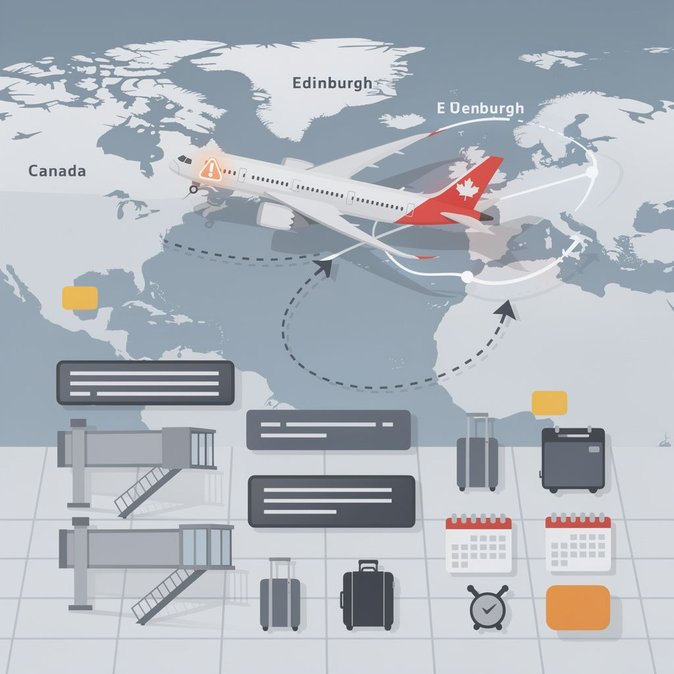
Air Canada passengers travelling from Edinburgh to Montréal faced an abrupt change of plans on Sunday after flight AC937, a Boeing 787-9, declared a general airborne emergency (squawk 7700) roughly one hour into its Atlantic crossing and executed a rapid descent from 38,000 feet to 10,000 feet. The aircraft, registration C-FRTU, turned back and landed safely at Edinburgh with emergency services on standby; no injuries were reported. While the carrier has yet to disclose the root cause, aviation analysts note that such descent profiles typically indicate a pressurisation fault, smoke alert or serious medical incident. Whatever the trigger, the operational fallout is immediate: the return rotation EDI–YUL is effectively cancelled, the airframe will undergo inspection, and crew duty-time limits could cascade into equipment swaps on subsequent days. Passengers missed onward connections from Montréal, and late-June trans-Atlantic capacity is already tight because of World Cup demand for Canadian gateways. Under the UK’s post-Brexit UK261 regime, Air Canada must provide meals, accommodation and re-routing; cash compensation applies only if the disruption is deemed within the airline’s control and not safety-related. Canada’s Air Passenger Protection Regulations (APPR) mirror that approach. Travellers were advised to rebook immediately via London Heathrow, Dublin or Toronto Pearson before inventory evaporated. Corporate travel managers with employees on the route are urged to document expenses for potential card-insurance claims and to review crisis-response protocols that cover rapid turn-backs over oceanic airspace. The incident also serves as a reminder that global-mobility teams should build generous connection buffers into trans-Atlantic itineraries this summer. A single-aisle A321LR now operates several Canada-Europe city-pairs with minimal spare capacity; any knock-on cancellation can ripple through networks for 72 hours. HR policies may therefore need to authorise premium-economy upgrades or alternate routings to maintain assignment start-dates. Transport Canada Civil Aviation will decide whether further inspection or an airworthiness directive is required. If maintenance findings show a systemic issue, other 787-9s in Air Canada’s fleet could see temporary groundings – an outcome that would tighten Canada-Europe availability even further during the peak relocation season.
Source: Air Traveler Club