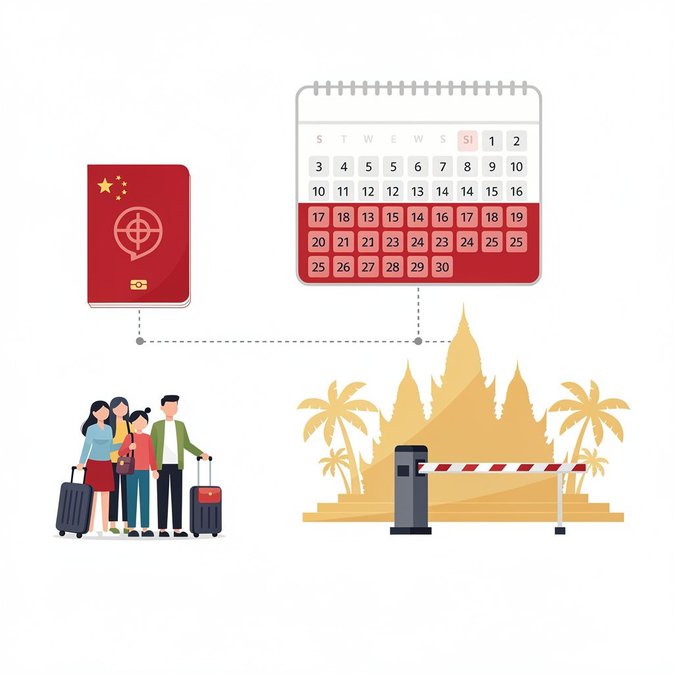
China’s National Immigration Administration (NIA) has reconfirmed that ordinary Russian passport-holders may continue to enter Mainland China without a visa for stays of up to 30 days until 24:00 on 14 September 2026. The clarification, published by Russian business wire AKM on 14 June, reiterates that the waiver applies to travel for tourism, business, visiting relatives, cultural exchanges and transit purposes. The Russian waiver is part of Beijing’s broader unilateral visa-free programme that now covers nearly 50 countries. First introduced in September 2025 as a one-year pilot to revive two-way trade and tourism after the pandemic, the policy quickly boosted Russian arrivals on major China Eastern, Aeroflot and Hainan Airlines routes linking Moscow, St Petersburg and Vladivostok with Beijing, Shanghai and Harbin. Bilateral tourist volume recovered to 92 % of its 2019 level in Q1 2026, according to Chinese customs statistics. For companies with operations spanning the Sino-Russian border—pipe-line engineering in Heilongjiang, e-commerce warehouses in Manzhouli, or energy projects in the Far East—the waiver removes the need to secure short-term M- (business) or F- (exchange) visas each trip. HR teams should, however, remind travelling staff that work, study and long-term media activities still require the appropriate Z, X or J visas, and that overstays beyond 30 days mandate a stay-permit application at a local Public Security Bureau. From a compliance perspective, the NIA has not imposed a limit on the number of visa-free entries, but travellers must carry proof of onward travel and accommodation. Russian citizens who lose or renew their passports while in China must visit the nearest Exit-Entry Bureau for an exit endorsement before departing the country. Chinese tour operators signal that the extension gives them 15 critical months to rebuild Russia-focused packages ahead of the 2026–27 winter sports season in Harbin and Altay. Multinationals should update their global-mobility portals immediately, because the waiver expires on 14 September 2026 unless Beijing issues a fresh decree.
Source: AKM EN