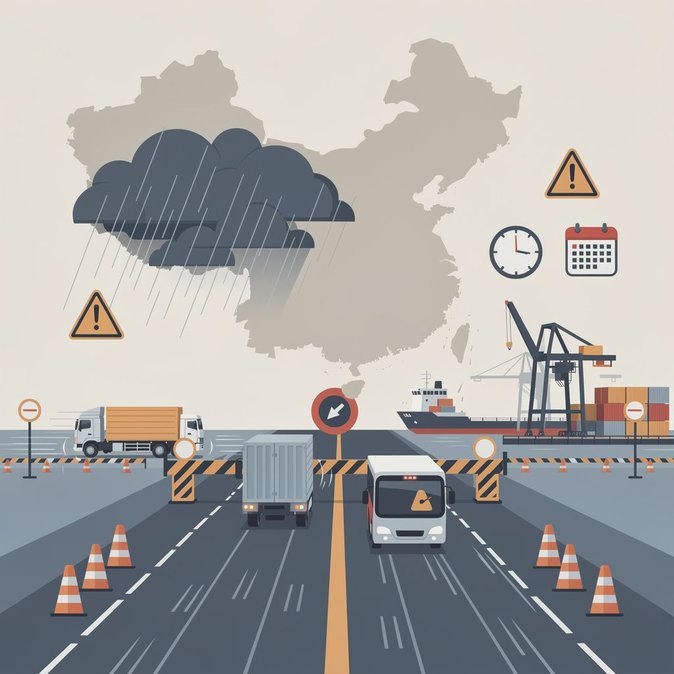
With the Central Meteorological Observatory issuing a yellow rain-storm alert for eight southern provinces, China’s Ministry of Transport (MOT) convened an emergency video call late on 13 June and, at 08:00 on 14 June, escalated to a level-3 flood-defence response. The directive targets Guangdong, Guangxi, Fujian, Zhejiang, Jiangxi, Hunan, Guizhou and Yunnan—regions that collectively host more than 43 percent of China’s Class A highways and five of its top ten container ports.
Meanwhile, companies that need to redeploy staff or fly in technical specialists at short notice can turn to VisaHQ for expedited China visa processing, passport renewals and document legalisation, services that remain available even when local transport networks are strained; full details are at https://www.visahq.com/china/
Provincial transport bureaux were told to pre-position pumping equipment, inspect expressway embankments and impose rolling traffic controls on sections vulnerable to landslides. Harbour masters along the Pearl River Delta must stagger vessel arrivals and strengthen mooring checks, while the Yangtze River Maritime Safety Administration has doubled patrol frequencies around key bridges and ferry crossings. For logistics managers, the order signals potential slow-downs in trucking transit times, especially on the G72, G80 and G60 corridors linking coastal factories with inland distribution centres. Freight forwarders moving time-sensitive bonded cargo through Nansha and Xiamen ports should build extra lead time and secure alternative rail routings where feasible. The MOT also urged passenger-transport operators to adjust schedules proactively and to activate ticket-refund mechanisms. Long-distance bus companies serving inter-provincial migrant workers have begun rerouting services, while ride-hailing platforms are ramping surge-pricing caps in flood-prone urban zones. Although the response level stops short of the highest tier, experience from previous monsoon seasons suggests that once rainfall totals exceed historical maxima—forecast for parts of Guangxi this week—higher-grade closures of expressway sections and regional airports are likely. Corporations with rotational assignees in manufacturing plants across the south should refresh business-continuity plans and verify staff emergency-contact trees.
Meanwhile, companies that need to redeploy staff or fly in technical specialists at short notice can turn to VisaHQ for expedited China visa processing, passport renewals and document legalisation, services that remain available even when local transport networks are strained; full details are at https://www.visahq.com/china/
Provincial transport bureaux were told to pre-position pumping equipment, inspect expressway embankments and impose rolling traffic controls on sections vulnerable to landslides. Harbour masters along the Pearl River Delta must stagger vessel arrivals and strengthen mooring checks, while the Yangtze River Maritime Safety Administration has doubled patrol frequencies around key bridges and ferry crossings. For logistics managers, the order signals potential slow-downs in trucking transit times, especially on the G72, G80 and G60 corridors linking coastal factories with inland distribution centres. Freight forwarders moving time-sensitive bonded cargo through Nansha and Xiamen ports should build extra lead time and secure alternative rail routings where feasible. The MOT also urged passenger-transport operators to adjust schedules proactively and to activate ticket-refund mechanisms. Long-distance bus companies serving inter-provincial migrant workers have begun rerouting services, while ride-hailing platforms are ramping surge-pricing caps in flood-prone urban zones. Although the response level stops short of the highest tier, experience from previous monsoon seasons suggests that once rainfall totals exceed historical maxima—forecast for parts of Guangxi this week—higher-grade closures of expressway sections and regional airports are likely. Corporations with rotational assignees in manufacturing plants across the south should refresh business-continuity plans and verify staff emergency-contact trees.