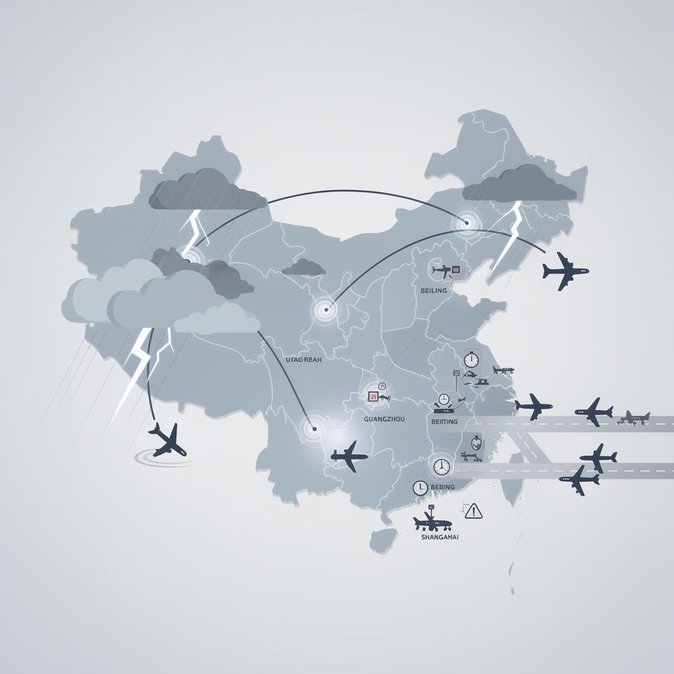
A fierce band of convective storms sweeping across southern and eastern China on 14 June caused the worst single-day disruption Chinese civil aviation has seen since last summer’s typhoon season. According to real-time data compiled by Nomad Lawyer and corroborated by airline operation control centres, 2,396 flights were delayed and 226 were cancelled nationwide as of 18:00 Beijing time. Guangzhou Baiyun and Shenzhen Bao’an bore the brunt, logging 379 and 295 delays respectively. The ripple effect quickly grid-locked the capital’s two airports—Beijing Capital and Daxing—with a combined 400-plus delays. Shanghai Pudong and Hongqiao added another 200 schedule changes, while secondary hubs from Hangzhou to Kunming reported cascading knock-ons. China Southern recorded the heaviest punctuality hit (639 delays), followed by China Eastern (428 delays, 93 outright cancellations) and flag-carrier Air China (332 delays, 37 cancellations). Forced ground stops, thunderstorm avoidance routings and flow-control windows slashed available air-space capacity, leaving check-in halls crowded with stranded business travellers and expatriate families racing to rearrange onward connections. The Civil Aviation Administration of China (CAAC) issued yellow rain-storm and blue convective-weather alerts, instructing airlines to waive change fees and to bolster customer-service staffing. Travel-risk consultancies advise corporates with time-critical movements into the Pearl River Delta or the Yangtze River Delta to build 24-hour buffers, secure refundable tickets and pre-book hotel contingencies through preferred travel management companies. Meteorological models show the storm belt lingering for another 36 hours. Mobility managers should monitor CAAC bulletins, encourage travellers to register on airline apps for push notifications, and remind staff that diverted flights may land at alternate airports hundreds of kilometres away—triggering new entry-exit formalities for those on international itineraries.
Source: Nomad Lawyer