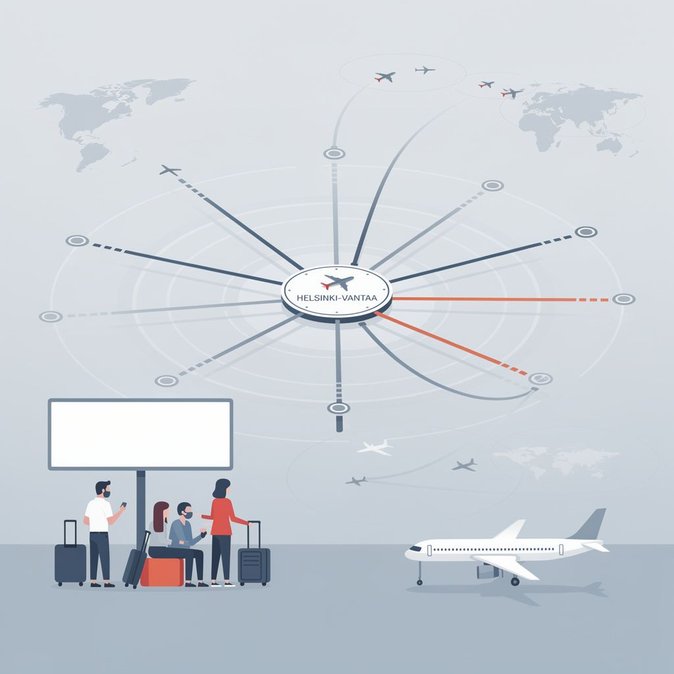
Finland’s flag-carrier Finnair was forced to ground part of its fleet on Sunday, 14 June 2026, after an unexpected systems failure cascaded through its operations hub at Helsinki-Vantaa Airport. According to airline-tracking data compiled early Sunday afternoon, Finnair cancelled eight departures and delayed a further 52, leaving thousands of passengers—many of them high-yield corporate travellers—stranded in the Schengen area’s northernmost long-haul gateway. The airline has not yet specified the root cause, but insiders pointed to a combined crew-rostering and aircraft-rotation mismatch triggered by an overnight IT glitch. Because Finnair’s network is built almost entirely on the hub-and-spoke model—with Helsinki funnelling traffic between Europe, North America and Asia—even a limited ground stop snowballed across the schedule. Morning bank flights to Berlin, London and Copenhagen missed their narrow connection windows; long-haul services to Chicago, Shanghai and Osaka subsequently lost their allocated slots, compounding delays across three continents. For business travellers, the timing could hardly be worse. Mid-June is peak season for Nordic corporate off-sites and Asia-bound summer production audits. Travellers holding through-tickets were advised by Finnair to accept automatic re-routing on oneworld partners where seats were available. EU-based passengers are entitled to compensation under Regulation 261/2004 when cancellations are within the airline’s control; Finnair, however, indicated that it would classify the incident as an “extraordinary operational disruption” pending a technical investigation, potentially limiting payouts. Corporate mobility managers should prepare for lingering knock-on effects: misplaced baggage, crew out-of-time issues in out-stations and aircraft stuck outside maintenance bases could all drag residual delays into Monday. Companies moving talent through Helsinki this week are urged to build 24-hour buffers into itineraries, issue blanket travel advisories and remind employees of Finnair’s chat-bot rebooking tools—which have proved faster than phone queues during previous disruptions. The incident also highlights a strategic vulnerability for Finland. As the country builds its post-NATO accession trade corridors to the United States and Indo-Pacific, Helsinki’s single-hub dependence is becoming a geopolitical as well as logistical risk. Industry analysts now expect renewed parliamentary pressure for a secondary long-haul capable runway at Tampere-Pirkkala or Oulu to improve network resilience—something the business community has advocated since the winter-weather shutdown of 2023.
Source: NomadLawyer