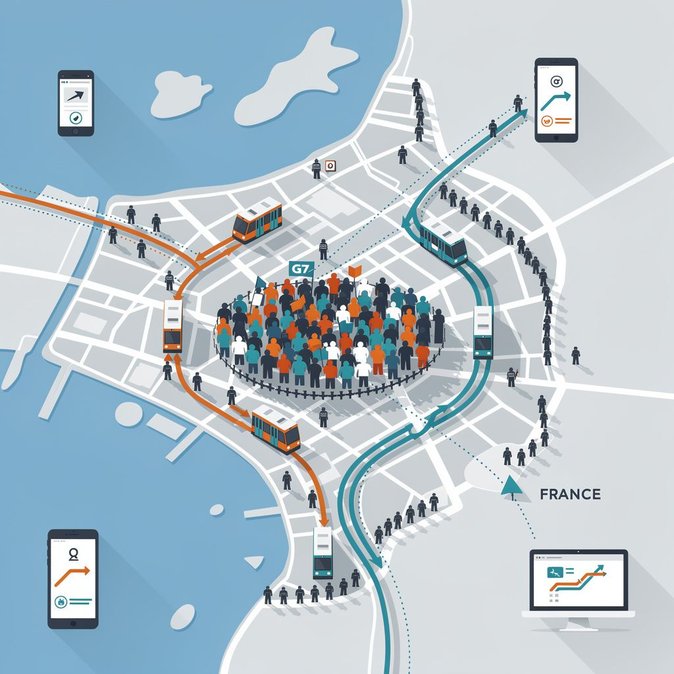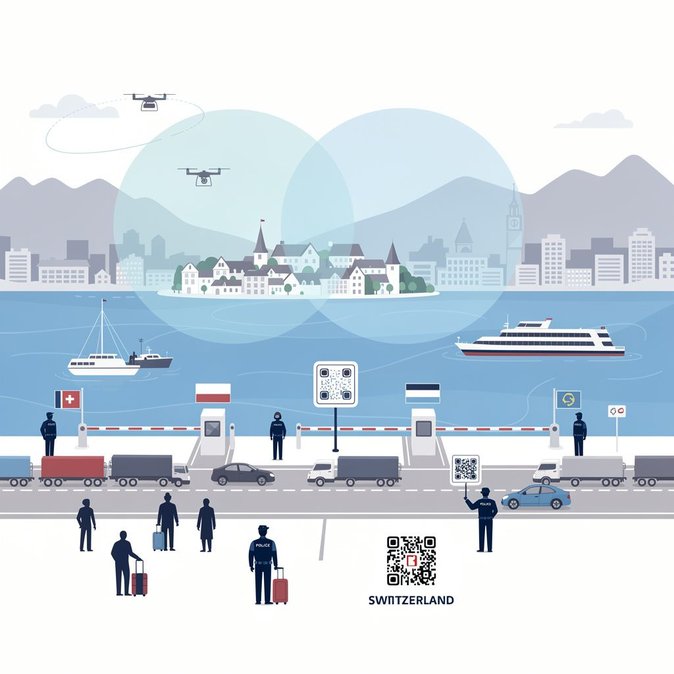
France will host the annual G7 leaders’ summit from 15-17 June at the Hôtel Royal in Évian-les-Bains. In preparation, Interior-Minister Gérald Darmanin has authorised an unprecedented security footprint inspired by lessons learned during the Paris 2024 Olympics. According to the Haute-Savoie prefecture, more than 16 000 personnel – 10 000 national police, 6 100 mobile gendarmes, 900 soldiers, 830 customs agents and around 1 000 firefighters and civil-protection staff – have been deployed. The plan centres on two concentric “red” and “blue” secure zones around Évian that came into force on 11 June. Entry is limited to accredited residents and workers carrying a scannable Pass G7 QR-code; heavy-goods vehicles over 19 tonnes are banned during daytime hours and lake-ferry services at Évian have been suspended. A drone exclusion zone and temporary no-fly area (NOTAM) have also been published for the summit period. To free up manpower, only seven of 35 border posts between the Geneva region and France remain open from 12-18 June. Cross-border commuters face diversions of up to 25 km, and the Swiss government has re-introduced Schengen-internal checks on the French frontier. The prefecture has urged companies to allow remote work, while business-travel managers are advising executives to route through Lyon-Saint-Exupéry or Zürich rather than Geneva Airport. Apart from the obvious political optics, the clamp-down has direct mobility implications for multinational firms in the Franco-Swiss corridor. Logistics operators must budget extra transit time, HR teams must brief travelling staff on Pass G7 procedures, and corporate security departments should monitor real-time road closures via the Préfecture 74 Telegram channel. Failure to carry a Pass G7 or to respect vehicle restrictions carries on-the-spot fines of up to €750 and vehicle impoundment. Although the restrictions are scheduled to lift at 20:00 on 17 June, authorities warn that dismantling checkpoints could take an additional 24 hours. Companies with time-critical shipments or expatriate moves are therefore planning buffers until 19 June before resuming normal cross-border operations.
Source: Le Monde