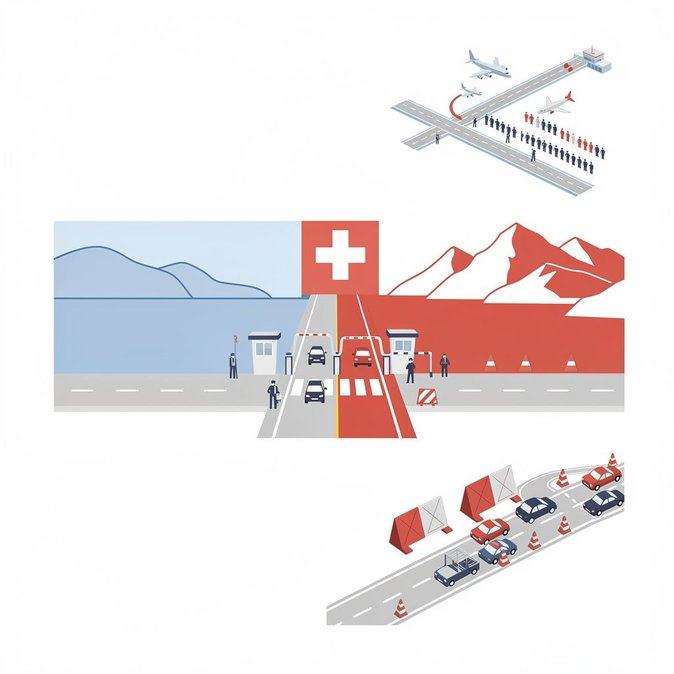
As leaders of the G7 nations gather just across Lake Geneva in Évian-les-Bains from 15 to 17 June 2026, Switzerland has reinstated Schengen-area border controls with France and rolled out an extensive security and traffic-management plan that will affect thousands of commuters and business travellers. The Federal Office for Customs and Border Security and the Canton of Geneva confirmed that only seven of the region’s 35 border crossings—Anières, Moillesulaz, Thônex-Vallard, Bardonnex, Perly, Meyrin and Ferney-Voltaire—remain open from 12 to 18 June. All travellers, including EU citizens, must carry passports or national ID cards and should expect systematic checks.
For travellers who realise at the last minute that additional documentation or an unexpected visa may be required, VisaHQ can provide rapid assistance. The platform’s Switzerland portal (https://www.visahq.com/switzerland/) offers up-to-date guidance on entry rules, handles express visa submissions and arranges secure courier pick-ups, helping business visitors and commuters navigate the temporary controls with minimal disruption.
South-bound traffic on the A1 motorway between Meyrin and Bardonnex is closed from 00:01 on Monday 15 June until 23:59 on Wednesday 17 June, with heavy-goods vehicles rerouted via alternative crossings in the Doubs department. Geneva Airport (GVA) remains operational but warns of possible flight delays and longer security lines as VIP aircraft movements take priority. The regional airspace is restricted from 10 to 18 June, and operators of private jets must obtain special slots. The city’s public-transport operator TPG has switched to a contingency timetable, suspending certain cross-border bus routes and advising commuters to allow up to 60 minutes of extra travel time. For multinational firms headquartered or holding meetings in the Geneva-Léman corridor, the disruption coincides with one of the busiest conference weeks of the year. Global-mobility teams have been advised to re-route arriving staff via Zurich or Basel where possible, arrange rail connections onward to western Switzerland, and secure hotel rooms on the Swiss side early—room rates in downtown Geneva have risen by an average of 35 % this week. Cross-border commuters from Haute-Savoie should carry employer attestations and, if they need to access the Évian ‘blue zone’, apply for the French PASS G7 QR code. Swiss authorities say the temporary controls are proportionate and will be lifted at 00:00 on 19 June. Nevertheless, the episode offers a reminder that Schengen’s principle of free movement can be suspended at short notice for major events. Companies operating in border regions should maintain updated employee-location data and contingency travel budgets to cushion operational shocks.
For travellers who realise at the last minute that additional documentation or an unexpected visa may be required, VisaHQ can provide rapid assistance. The platform’s Switzerland portal (https://www.visahq.com/switzerland/) offers up-to-date guidance on entry rules, handles express visa submissions and arranges secure courier pick-ups, helping business visitors and commuters navigate the temporary controls with minimal disruption.
South-bound traffic on the A1 motorway between Meyrin and Bardonnex is closed from 00:01 on Monday 15 June until 23:59 on Wednesday 17 June, with heavy-goods vehicles rerouted via alternative crossings in the Doubs department. Geneva Airport (GVA) remains operational but warns of possible flight delays and longer security lines as VIP aircraft movements take priority. The regional airspace is restricted from 10 to 18 June, and operators of private jets must obtain special slots. The city’s public-transport operator TPG has switched to a contingency timetable, suspending certain cross-border bus routes and advising commuters to allow up to 60 minutes of extra travel time. For multinational firms headquartered or holding meetings in the Geneva-Léman corridor, the disruption coincides with one of the busiest conference weeks of the year. Global-mobility teams have been advised to re-route arriving staff via Zurich or Basel where possible, arrange rail connections onward to western Switzerland, and secure hotel rooms on the Swiss side early—room rates in downtown Geneva have risen by an average of 35 % this week. Cross-border commuters from Haute-Savoie should carry employer attestations and, if they need to access the Évian ‘blue zone’, apply for the French PASS G7 QR code. Swiss authorities say the temporary controls are proportionate and will be lifted at 00:00 on 19 June. Nevertheless, the episode offers a reminder that Schengen’s principle of free movement can be suspended at short notice for major events. Companies operating in border regions should maintain updated employee-location data and contingency travel budgets to cushion operational shocks.