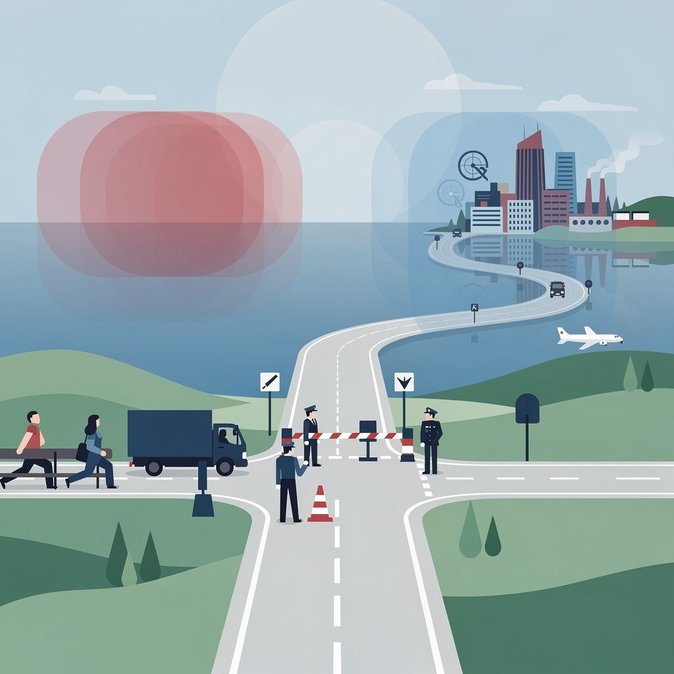
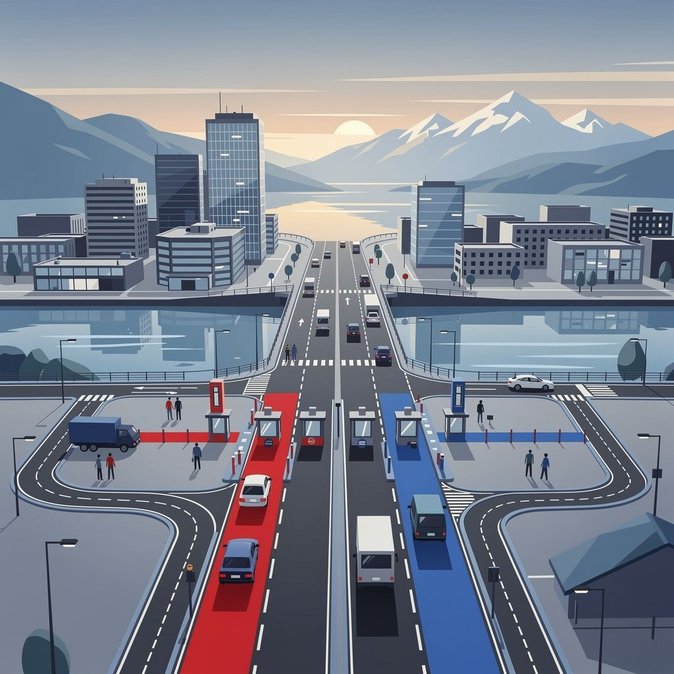
As the 52ᵗʰ G7 summit in Évian-les-Bains enters its closing session today, 17 June 2026, corporate mobility managers are grappling with an unusually tight security cordon that has reshaped cross-border travel around Lake Geneva for the past week. Under a joint French-Swiss security plan, internal Schengen checks were reinstated on 10 June and will remain in force until 19 June, covering every road, rail and ferry crossing between Haute-Savoie and the cantons of Geneva, Vaud and Valais. A detailed briefing published on 16 June by Planète Grandes Écoles – and echoed by cantonal information portals – sets out a two-zone system: a “red zone” around the Hôtel Royal venue (access only with presidential-level accreditation) and a wider “blue zone” that requires a digital Pass G7 issued by the Haute-Savoie prefecture. Even normally open minor border points such as Veigy-Foncenex and Chens-sur-Léman are closed; commuters must detour via one of seven authorised posts including Ferney-Voltaire, Bardonnex and Vallard. For globally-mobile staff at multinational headquarters in Geneva, Lausanne and the neighbouring French technopole of Archamps, the impact has been tangible: shuttle times have doubled at peak hours, same-day visas for third-country nationals have been suspended and telecom firms have told non-essential technicians to remain on telework until the controls lift.
![Last day of G7 Évian summit triggers temporary Franco-Swiss border controls and local travel lockdowns]()
At times like this, VisaHQ’s France portal (https://www.visahq.com/france/) can step in to fast-track alternative Schengen visa arrangements, pre-clear digital travel passes and push real-time alerts to HR dashboards, sparing mobility managers from last-minute scrambles as restrictions evolve.
CERN, whose campus straddles the frontier, activated a special pass system and encouraged external contractors to postpone site visits after noon on 14 June. Although Schengen rules allow member states to re-introduce temporary checks for security reasons, the G7 operation is one of the broadest since COP 21 in 2015. Swiss authorities have deployed up to 3 000 troops in support, while France has rerouted the local segment of the baccalauréat exams to Thonon-les-Bains. Logistics providers report that groupage trucks bound for Alpine resorts are queuing for up to three hours; companies shipping time-critical pharma or semiconductor components are diverting through Basel/Weil-am-Rhein or Mont Blanc Tunnel corridors. The good news is that the end is in sight. The summit communiqué is due mid-afternoon, after which delegations will depart by helicopter shuttle to Geneva Airport or by motorcade to Lyon Saint-Exupéry. The Haute-Savoie prefecture says the blue zone will shrink progressively from 22:00 tonight and border posts should return to normal hours by Friday morning. Mobility teams should keep current passes active until the QR-code system is deactivated and expect residual congestion on 18 June as barriers are dismantled.
At times like this, VisaHQ’s France portal (https://www.visahq.com/france/) can step in to fast-track alternative Schengen visa arrangements, pre-clear digital travel passes and push real-time alerts to HR dashboards, sparing mobility managers from last-minute scrambles as restrictions evolve.
CERN, whose campus straddles the frontier, activated a special pass system and encouraged external contractors to postpone site visits after noon on 14 June. Although Schengen rules allow member states to re-introduce temporary checks for security reasons, the G7 operation is one of the broadest since COP 21 in 2015. Swiss authorities have deployed up to 3 000 troops in support, while France has rerouted the local segment of the baccalauréat exams to Thonon-les-Bains. Logistics providers report that groupage trucks bound for Alpine resorts are queuing for up to three hours; companies shipping time-critical pharma or semiconductor components are diverting through Basel/Weil-am-Rhein or Mont Blanc Tunnel corridors. The good news is that the end is in sight. The summit communiqué is due mid-afternoon, after which delegations will depart by helicopter shuttle to Geneva Airport or by motorcade to Lyon Saint-Exupéry. The Haute-Savoie prefecture says the blue zone will shrink progressively from 22:00 tonight and border posts should return to normal hours by Friday morning. Mobility teams should keep current passes active until the QR-code system is deactivated and expect residual congestion on 18 June as barriers are dismantled.