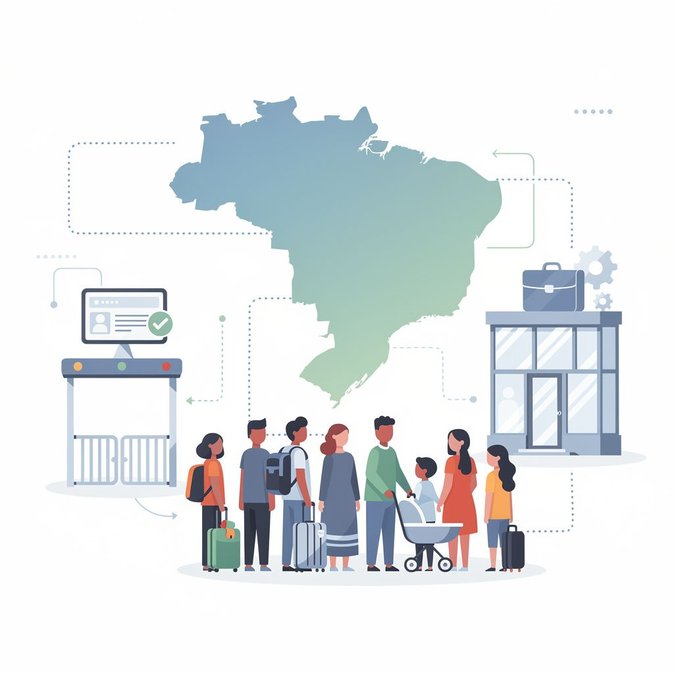
The Ministry of Labour and Employment (MTE) cut the ribbon on the 12th national ‘Casa do Trabalhador’ on 19 June. The 450-square-metre facility in downtown Belém consolidates multiple employment services—from job-matching to unemployment insurance—in a single, fully accessible space. Critically for global-mobility teams, the branch houses an immigration service window empowered to issue the digital Carteira de Trabalho (work booklet) and advise employers on hiring foreigners.
To further streamline cross-border assignments, corporate mobility teams can leverage VisaHQ’s Brazil portal (https://www.visahq.com/brazil/), which offers end-to-end visa processing, document pre-screening, and real-time status tracking that dovetail with the Casa do Trabalhador’s new workflows—reducing lead times and sparing both HR and assignees extra trips to consulates.
The ‘one-stop shop’ model mirrors best practices seen in Portugal’s AIMA and Canada’s Service Ontario: migrants can complete biometric enrolment, sign up for Portuguese classes and schedule social-security appointments without shuttling between agencies. For local firms struggling with skills shortages in the Amazon gateway city, the centre offers targeted recruitment drives and a new “fast-track” lane for positions aligned with Brazil’s Critical Occupations List. MTE officials explained that each Casa will connect to the federal e-Social platform, allowing HR departments to validate foreign workers’ tax IDs in real time—an administrative hurdle that has delayed project start-dates for multinationals in the energy and mining sectors. Belém’s launch is also a G20 legacy project: the city will host environment and labour side-events during COP-30 in 2028. Authorities expect an influx of expatriate staff supporting conference logistics; the new centre is designed to absorb that demand. Companies operating across Brazil should watch the roll-out calendar: five more Casas—Manaus, Salvador, Curitiba, Recife and Porto Alegre—are slated to open before year-end, potentially simplifying onboarding in those markets.
To further streamline cross-border assignments, corporate mobility teams can leverage VisaHQ’s Brazil portal (https://www.visahq.com/brazil/), which offers end-to-end visa processing, document pre-screening, and real-time status tracking that dovetail with the Casa do Trabalhador’s new workflows—reducing lead times and sparing both HR and assignees extra trips to consulates.
The ‘one-stop shop’ model mirrors best practices seen in Portugal’s AIMA and Canada’s Service Ontario: migrants can complete biometric enrolment, sign up for Portuguese classes and schedule social-security appointments without shuttling between agencies. For local firms struggling with skills shortages in the Amazon gateway city, the centre offers targeted recruitment drives and a new “fast-track” lane for positions aligned with Brazil’s Critical Occupations List. MTE officials explained that each Casa will connect to the federal e-Social platform, allowing HR departments to validate foreign workers’ tax IDs in real time—an administrative hurdle that has delayed project start-dates for multinationals in the energy and mining sectors. Belém’s launch is also a G20 legacy project: the city will host environment and labour side-events during COP-30 in 2028. Authorities expect an influx of expatriate staff supporting conference logistics; the new centre is designed to absorb that demand. Companies operating across Brazil should watch the roll-out calendar: five more Casas—Manaus, Salvador, Curitiba, Recife and Porto Alegre—are slated to open before year-end, potentially simplifying onboarding in those markets.