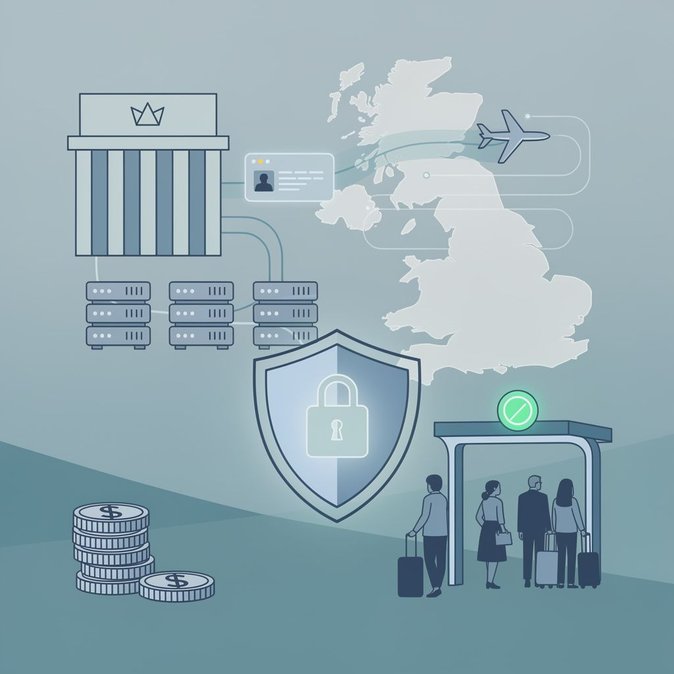
The Cabinet Office and HM Treasury on 22 June released a three-page Procurement Policy Note (PPN) instructing all government departments and arm’s-length bodies to consider national-security resilience ahead of short-term cost when purchasing goods and services. Although the guidance is aimed broadly at four ‘critical sectors’—shipbuilding, steel, artificial intelligence (AI) and energy infrastructure—it also references the need to protect ‘foundational assets’ essential to UK sovereignty, a category that officials privately confirm includes border-security technology and visa-processing infrastructure.
Amid this evolving procurement landscape, VisaHQ—a global visa and passport services specialist—can help organisations and travellers stay compliant as the UK modernises its border systems. Its London-based platform (https://www.visahq.com/united-kingdom/) offers real-time tracking of eVisas, ETAs and passport applications, giving mobility managers early visibility into changing requirements while the government upgrades its procurement and data-sovereignty safeguards.
Under the new rules, departments may invoke the National Security Exemption within the Procurement Act 2023 to sidestep lowest-price tenders if doing so strengthens domestic capability or protects sensitive data flows. In practice, this could accelerate upgrades to e-Gate facial-recognition systems, digital visa platforms and biometric enrolment kits—areas where the Home Office has faced criticism for relying on overseas vendors. The move follows this year’s temporary closure of the Strait of Hormuz and the 2025 ransomware attack on a major visa-outsourcing supplier, both of which exposed supply-chain vulnerabilities. For mobility managers, the note signals that next-generation border systems—from eVisas to the £10 Electronic Travel Authorisation (ETA)—are more likely to be developed in-country, potentially reducing geopolitical risk but increasing project cost in the short term. British tech SMEs focused on identity management stand to benefit from a ‘Buy Secure, Buy British’ tilt, while multinational relocation firms should monitor whether tighter security vetting prolongs procurement lead-times for outsourced appointment centres. The guidance also requires early engagement with sector ‘lead’ departments—such as the Department for Science, Innovation & Technology for AI—during tender design. Suppliers hoping to bid for border-tech contracts will need to demonstrate robust data-sovereignty arrangements and resilient domestic support capacity. Mobility stakeholders should therefore build advocacy coalitions early, ensuring that traveller-experience considerations are not crowded out by purely security-driven specifications. Although no immediate budget lines were announced, the Treasury’s accompanying letter permits accounting officers to factor in long-term resilience and economic-growth benefits when assessing value for money. That flexibility could unlock delayed capital spending on new biometric kiosks at regional airports before the February 2026 ETA enforcement deadline, smoothing the path for business travellers and tourists alike.
Amid this evolving procurement landscape, VisaHQ—a global visa and passport services specialist—can help organisations and travellers stay compliant as the UK modernises its border systems. Its London-based platform (https://www.visahq.com/united-kingdom/) offers real-time tracking of eVisas, ETAs and passport applications, giving mobility managers early visibility into changing requirements while the government upgrades its procurement and data-sovereignty safeguards.
Under the new rules, departments may invoke the National Security Exemption within the Procurement Act 2023 to sidestep lowest-price tenders if doing so strengthens domestic capability or protects sensitive data flows. In practice, this could accelerate upgrades to e-Gate facial-recognition systems, digital visa platforms and biometric enrolment kits—areas where the Home Office has faced criticism for relying on overseas vendors. The move follows this year’s temporary closure of the Strait of Hormuz and the 2025 ransomware attack on a major visa-outsourcing supplier, both of which exposed supply-chain vulnerabilities. For mobility managers, the note signals that next-generation border systems—from eVisas to the £10 Electronic Travel Authorisation (ETA)—are more likely to be developed in-country, potentially reducing geopolitical risk but increasing project cost in the short term. British tech SMEs focused on identity management stand to benefit from a ‘Buy Secure, Buy British’ tilt, while multinational relocation firms should monitor whether tighter security vetting prolongs procurement lead-times for outsourced appointment centres. The guidance also requires early engagement with sector ‘lead’ departments—such as the Department for Science, Innovation & Technology for AI—during tender design. Suppliers hoping to bid for border-tech contracts will need to demonstrate robust data-sovereignty arrangements and resilient domestic support capacity. Mobility stakeholders should therefore build advocacy coalitions early, ensuring that traveller-experience considerations are not crowded out by purely security-driven specifications. Although no immediate budget lines were announced, the Treasury’s accompanying letter permits accounting officers to factor in long-term resilience and economic-growth benefits when assessing value for money. That flexibility could unlock delayed capital spending on new biometric kiosks at regional airports before the February 2026 ETA enforcement deadline, smoothing the path for business travellers and tourists alike.