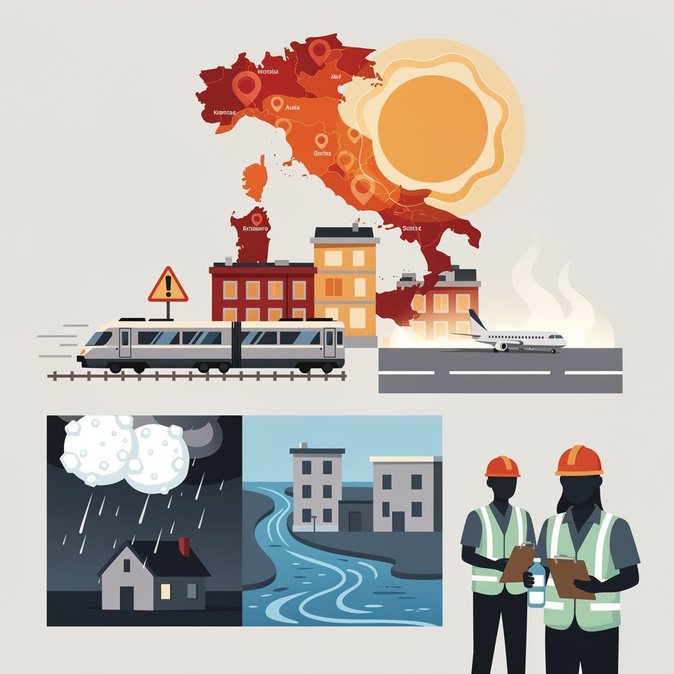
Italy’s civil-protection agency has issued red-level weather alerts for 22 cities—from Bolzano to Palermo—as a powerful ‘heat dome’ pushes daytime temperatures towards 40 °C and fuels violent Alpine storms. The heat is already straining infrastructure: a power blackout in Padua on Sunday paralysed tram lines and forced passengers onto replacement buses, while tarmac ‘soft spots’ at Verona Airport prompted temporary runway inspections. Meteorologists warn that the accumulated thermal energy will collide with a cold front mid-week, creating a high probability of hail, downbursts and micro-flooding along key motorway corridors (A4 Turin–Trieste, A22 Modena–Brenner). A mudslide in South Tyrol has injured five people and led to the precautionary evacuation of 69 residents, disrupting local bus routes that connect with cross-border services to Austria. For international assignees and tourists, the dual threat of heat stress and sudden storms poses practical challenges. Trenitalia has lowered maximum train speeds on exposed high-speed segments during the hottest hours, adding up to 25 minutes to Milan–Rome journeys. Several municipalities—including Florence—have activated ‘bollino rosso’ working-hour restrictions for outdoor labour; delays to construction and relocation fit-outs are expected. Employers with staff in Italy should update risk assessments, remind personnel to stay hydrated, and ensure company travel-insurance policies cover weather-related delays. Air-conditioning failures are common in older serviced apartments; mobility providers are advising expatriates to test units and locate the nearest emergency pharmacy stocking rehydration salts. Travellers flying via smaller regional airports should check that afternoon departures have not been weight-restricted—air-density penalties can force airlines to shed cargo or passengers. Climate scientists attribute the heatwave to a stationary subtropical ridge exacerbated by the ongoing El Niño phase. With Italy’s summer only just beginning, authorities caution that further extreme-temperature episodes are likely, making contingency planning a priority for global mobility teams.
Source: Anadolu Agency