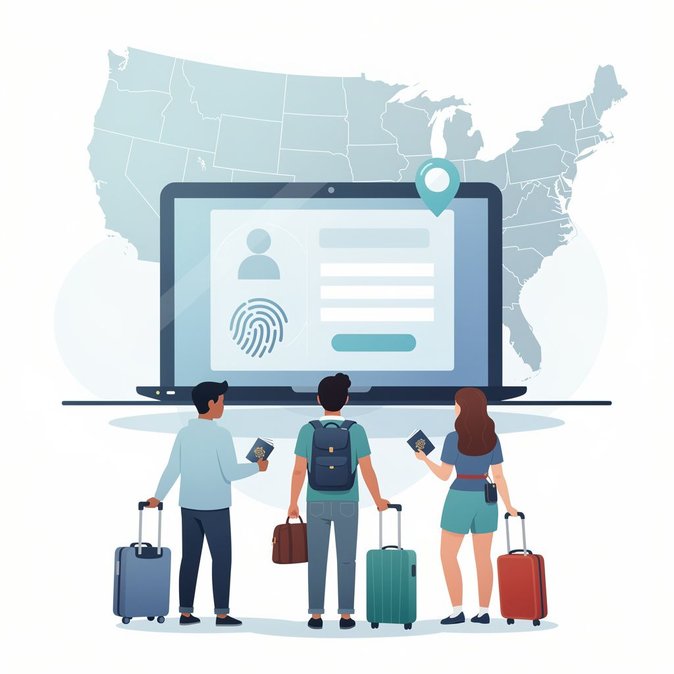
The Department of Homeland Security has published a final rule tightening long-dormant alien-registration requirements—and, for the first time, offers an online tool to help visitors check whether they must register. The rule, signed 29 June and publicised on 1 July, adopts a 2025 interim version with technical tweaks and introduces Form G-325R for electronic filing. All non-citizens aged 14 or older who were not fingerprinted during the visa process and remain in the United States for 30 days or more must register; parents must file on behalf of younger children.
If you’re unsure how the new rule affects your staff or personal travel plans, VisaHQ can help. Its U.S. portal (https://www.visahq.com/united-states/) provides customised checklists, electronic filing support and real-time status updates, allowing travellers and HR teams to meet DHS registration deadlines without guesswork.
Failure to comply carries penalties of up to six months in jail or a US$5,000 fine. Registrants over 18 must carry proof of registration at all times. For global-mobility managers the change matters on two fronts. First, long-term assignees entering on visa-waiver ESTA, B-1/B-2 or certain dependent statuses may now face a second compliance step after arrival. Second, USCIS will issue electronic evidence instead of the old paper I-94 “green-stripe” card, forcing HR teams to update onboarding checklists and travel-document audits. DHS says digitising the 80-year-old registration regime closes gaps exploited by overstays and makes it easier to match fingerprints to criminal and terrorism databases. Civil-rights groups counter that requiring all long-term visitors to carry registration proof could lead to more interior checkpoints and profiling. Public comments on further amendments—such as expanding biometric re-registration every five years—are open until 28 August 2026.
If you’re unsure how the new rule affects your staff or personal travel plans, VisaHQ can help. Its U.S. portal (https://www.visahq.com/united-states/) provides customised checklists, electronic filing support and real-time status updates, allowing travellers and HR teams to meet DHS registration deadlines without guesswork.
Failure to comply carries penalties of up to six months in jail or a US$5,000 fine. Registrants over 18 must carry proof of registration at all times. For global-mobility managers the change matters on two fronts. First, long-term assignees entering on visa-waiver ESTA, B-1/B-2 or certain dependent statuses may now face a second compliance step after arrival. Second, USCIS will issue electronic evidence instead of the old paper I-94 “green-stripe” card, forcing HR teams to update onboarding checklists and travel-document audits. DHS says digitising the 80-year-old registration regime closes gaps exploited by overstays and makes it easier to match fingerprints to criminal and terrorism databases. Civil-rights groups counter that requiring all long-term visitors to carry registration proof could lead to more interior checkpoints and profiling. Public comments on further amendments—such as expanding biometric re-registration every five years—are open until 28 August 2026.