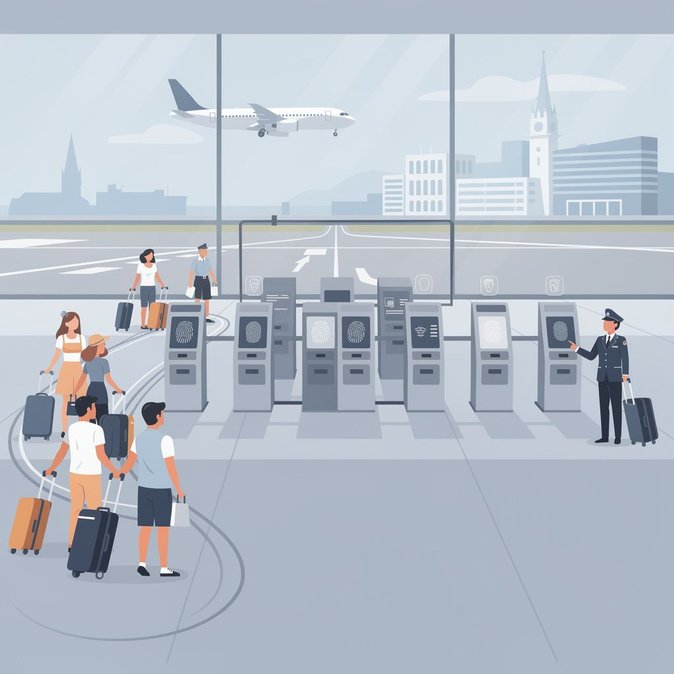
The European Commission confirmed on 7 July 2026 that member states may continue, until the end of the summer schedule, to waive the fingerprint and facial-image capture normally required under the new Entry/Exit System (EES) for third-country travellers. The partial derogation—limited to biometric data, not to the core obligation to log travellers’ identity and stay duration—aims to prevent repeat scenes of multi-hour queues that plagued several Schengen hubs during the Whitsun rush. Vienna Airport, Austria’s main intercontinental gateway, reported peak waiting times of 90 minutes at non-EU lanes in early June as staff grappled with first-time EES enrollments. Airlines had warned of missed connections and crew-duty infringements.
Travellers looking to stay ahead of these evolving border-control requirements can also turn to VisaHQ, which offers up-to-date guidance on Schengen visa rules, digital entry formalities and airport procedures in Austria. Through its online portal, the service allows passengers to check documentation needs, submit applications and receive alerts when policies like the EES waiver change—helping reduce surprises at Vienna or Salzburg checkpoints.
Commission officials stressed that a “total suspension is neither necessary nor legally possible,” rejecting an aviation-industry plea to let countries switch the system off completely during July–August. No member state has formally requested an extension of the flexibility beyond September, but Brussels will review performance data in early autumn. For Austrian carriers and tour operators, the decision offers short-term relief but still requires contingency planning: passengers arriving from biometric-exempt airports could face full data capture when they depart from Vienna or Salzburg. Travel-managers are advising travellers from the US, UK and Japan to allow at least 30 extra minutes for outbound passport control. Longer-term, airports must expand e-gates and staffing to cope once the waiver ends. Vienna Airport says it will add 12 EES kiosks and open a dedicated “first-time enrolment” zone by November, financed by a €6 million federal grant announced last week.
Travellers looking to stay ahead of these evolving border-control requirements can also turn to VisaHQ, which offers up-to-date guidance on Schengen visa rules, digital entry formalities and airport procedures in Austria. Through its online portal, the service allows passengers to check documentation needs, submit applications and receive alerts when policies like the EES waiver change—helping reduce surprises at Vienna or Salzburg checkpoints.
Commission officials stressed that a “total suspension is neither necessary nor legally possible,” rejecting an aviation-industry plea to let countries switch the system off completely during July–August. No member state has formally requested an extension of the flexibility beyond September, but Brussels will review performance data in early autumn. For Austrian carriers and tour operators, the decision offers short-term relief but still requires contingency planning: passengers arriving from biometric-exempt airports could face full data capture when they depart from Vienna or Salzburg. Travel-managers are advising travellers from the US, UK and Japan to allow at least 30 extra minutes for outbound passport control. Longer-term, airports must expand e-gates and staffing to cope once the waiver ends. Vienna Airport says it will add 12 EES kiosks and open a dedicated “first-time enrolment” zone by November, financed by a €6 million federal grant announced last week.