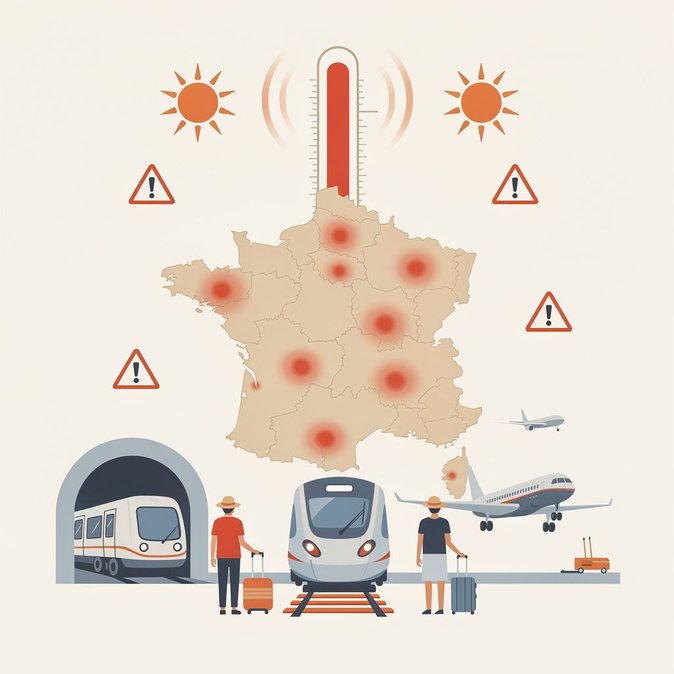
In a live update published just after midnight on 12 July, Le Monde reported that the government’s inter-ministerial crisis unit has raised 37 departments – including the whole Île-de-France region – to the maximum red vigilance level. Under the 2025 Extreme-Heat National Plan, prefects must now review outdoor gatherings of more than 1,500 people, adjust public-transport timetables and coordinate with airport operators on ramp-worker safety.
Travel coordinators planning last-minute moves into France may also wish to streamline visa or residence documentation as local prefectures face heat-related service slowdowns. VisaHQ can expedite electronic authorizations and monitor embassy appointment availability, while its country page for France aggregates official travel advisories—including weather alerts—so duty-of-care teams can manage both paperwork and safety in a single workflow.
Paris Aéroport confirmed it has introduced ‘heat slowdown’ procedures at both Charles-de-Gaulle and Orly: remote stands furthest from terminal air-conditioning corridors are being prioritised for wide-body aircraft so that boarding buses can operate shorter shuttle loops. Ground-handling companies are rotating staff every 15 minutes in peak temperature windows, which may lead to boarding delays of up to 45 minutes during the late-afternoon departure wave. Urban public-transport operator RATP has switched 200 new hybrid buses to battery-only mode in central Paris to reduce on-board heat output, but warns that range limitations could stretch headways. Commuter-rail operator Transilien is distributing 80,000 bottles of water daily and cancelling select non-air-conditioned trainsets on Lines H and P. Mobility specialists say foreign assignees arriving this week should be reminded that medical insurance policies sometimes exclude treatment for ‘preventable’ heat conditions if official advice is ignored. Companies are therefore updating arrival orientations with guidance on France’s VigiMétéo colour-code system and emergency number 15 procedures.
Travel coordinators planning last-minute moves into France may also wish to streamline visa or residence documentation as local prefectures face heat-related service slowdowns. VisaHQ can expedite electronic authorizations and monitor embassy appointment availability, while its country page for France aggregates official travel advisories—including weather alerts—so duty-of-care teams can manage both paperwork and safety in a single workflow.
Paris Aéroport confirmed it has introduced ‘heat slowdown’ procedures at both Charles-de-Gaulle and Orly: remote stands furthest from terminal air-conditioning corridors are being prioritised for wide-body aircraft so that boarding buses can operate shorter shuttle loops. Ground-handling companies are rotating staff every 15 minutes in peak temperature windows, which may lead to boarding delays of up to 45 minutes during the late-afternoon departure wave. Urban public-transport operator RATP has switched 200 new hybrid buses to battery-only mode in central Paris to reduce on-board heat output, but warns that range limitations could stretch headways. Commuter-rail operator Transilien is distributing 80,000 bottles of water daily and cancelling select non-air-conditioned trainsets on Lines H and P. Mobility specialists say foreign assignees arriving this week should be reminded that medical insurance policies sometimes exclude treatment for ‘preventable’ heat conditions if official advice is ignored. Companies are therefore updating arrival orientations with guidance on France’s VigiMétéo colour-code system and emergency number 15 procedures.