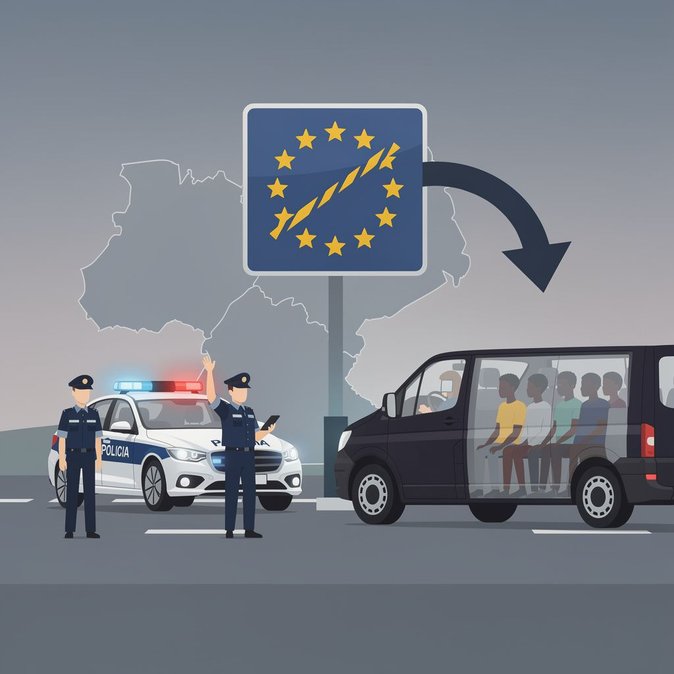
A routine patrol by Poland’s Border Guard on the S10 near Dołuje, only a few hundred metres from the German frontier, uncovered a people-smuggling attempt involving five African nationals hidden in a Volkswagen Passat. The Ukrainian driver, who admitted taking payment to transport the group from Lithuania to Germany, was arrested on 11 July and formally charged on 14 July with organising illegal border crossings and using a forged Ukrainian driving licence. The passengers – four Ethiopians and one Eritrean – had earlier slipped into Poland from Lithuania after leaving an open reception centre in Latvia. All five pleaded guilty to illegal entry and accepted six-month suspended prison sentences. Under EU readmission rules they were the next day transferred back to Lithuania at the Budzisko-Kalvarija checkpoint. Prosecutors seized the smuggler’s car and a cash stash believed to be profits from a previous run on 28 June when he allegedly transported four other migrants into Germany. If convicted, he faces up to eight years in prison. The incident illustrates the evolving secondary-movement route that now threads from Latvia through Lithuania and Poland to Germany as smugglers try to bypass the heavily policed Polish-Belarusian border. Mobility managers moving staff or equipment by road between Poland and Germany should expect intermittent spot checks on the S3/S10 corridors and prepare documentation to avoid delays. From a policy perspective, Warsaw’s interior ministry is using this and similar arrests to argue for the ongoing internal Schengen controls on the Slovak and German borders that Poland re-introduced last autumn.
Source: Komenda Główna Straży Granicznej