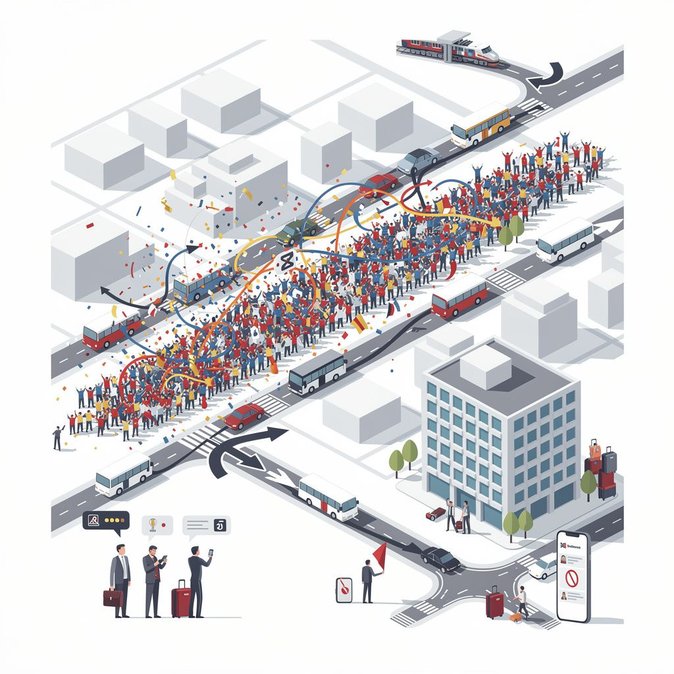
Fresh from lifting the 2026 FIFA World Cup in New York, La Roja rode an open-top bus through Madrid on 20 July—but behind the celebrations lay one of the largest ad-hoc mobility operations Spain’s capital has mounted in a decade. City Hall, the Regional Transport Consortium (CRTM) and the National Police activated a phased traffic-management plan covering Cibeles, Gran Vía, Paseo de Recoletos and neighbouring arteries from midnight on 18 July through the evening of the parade. More than 40 EMT bus lines—including the airport express—were diverted, while Bicimad docking stations and several Cercanías commuter-rail entrances at Recoletos were temporarily closed. Authorities estimated that some 650,000 spectators converged on the 4.8-kilometre route. For corporate travellers and residents, the immediate impact was severe: average weekday journey times across Madrid’s inner ring rose 68 %, and ride-hailing surge pricing averaged €32 for a normally €12 trip from Chamartín to Atocha. Several downtown hotels reported early check-outs so guests could avoid being ‘parade-locked’ inside restricted zones. The city’s mobility department said advance notice to business communities helped avoid worse gridlock; 3,400 companies enrolled in a new SMS alert system piloted after last year’s Pride celebrations. Nevertheless, failure-to-appear claims spiked at Madrid’s courts after litigants and lawyers were unable to reach hearings, illustrating the knock-on effects of large-scale civic events on business continuity. Looking ahead, Madrid plans to integrate real-time crowd-density data from telecom operators into its event dashboards and to expand dedicated ‘green corridors’ that keep airport-bound traffic flowing. Mobility managers should note that the city is likely to replicate the model for the Pope’s visit in September and for the annual UN Climate Summit in November, making proactive route audits and hotel re-bookings essential.
Source: CRTM / El País