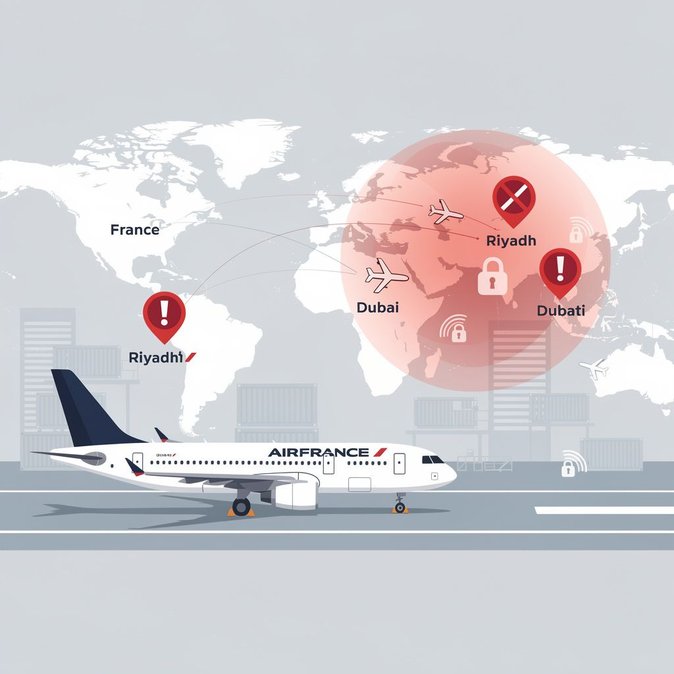
Air France has temporarily grounded its services to three key Middle-East hubs – Dubai, Riyadh and Beirut – after French and European aviation safety authorities warned of heightened risks to civil aviation in Gulf airspace. In a notice published late on 20 July and confirmed on 21 July, the carrier said all flights to and from Riyadh are cancelled until 24 July, Dubai until 27 July and Beirut until 2 August. Passengers holding tickets on the affected routes may rebook or seek refunds at no additional cost. Although the French flag-carrier has made short-term suspensions before, this is the first time since 2023 that three separate Middle-East stations have been dropped simultaneously. The decision follows a conflict-zone bulletin from the European Union Aviation Safety Agency (EASA) that advises airlines to avoid the lower Gulf region until at least 29 July because of the risk of drone and missile activity spilling over regional air routes. Rival European airlines including KLM and British Airways have introduced similar route changes or extended existing suspensions. The move is highly disruptive for French corporates with heavy exposure to the Gulf – notably oil-field services, defence contractors and luxury-retail groups that rely on the high-yield Paris–Dubai sector. Travel-management companies estimate that more than 12,000 premium-class bookings will have to be re-routed or delayed during the current suspension window. Freight forwarders are also scrambling; Air France’s nightly 777-F belly-cargo departure from Paris-CDG to Dubai normally carries temperature-controlled pharmaceuticals, aerospace parts and haute-couture shipments. Operationally, Air France must now find alternative routings to protect onward connectivity for passengers heading to Asia-Pacific. Most itineraries are being re-protected via Doha (with codeshare partner Qatar Airways) or via Muscat. However, capacity is tight and journey times are up to four hours longer, raising duty-time and crew-cost considerations. Should the suspension be prolonged into the northern-hemisphere winter schedule, analysts warn that Air France could face missing targets in its high-margin Business Segment, where Middle-East corporate traffic forms a key pillar. For travel managers, the advice is to contact Air France or GDS partners immediately to secure seats on permitted routings, to double-check visa requirements for any newly introduced transit points, and to remind travellers that European carriers may invoke force-majeure clauses that limit compensation for consequential losses. Insurance providers are already flagging the importance of “war and terrorism” extensions, which many basic corporate travel policies exclude. As the regional security picture remains fluid, further short-notice changes cannot be ruled out.
Source: Euronews