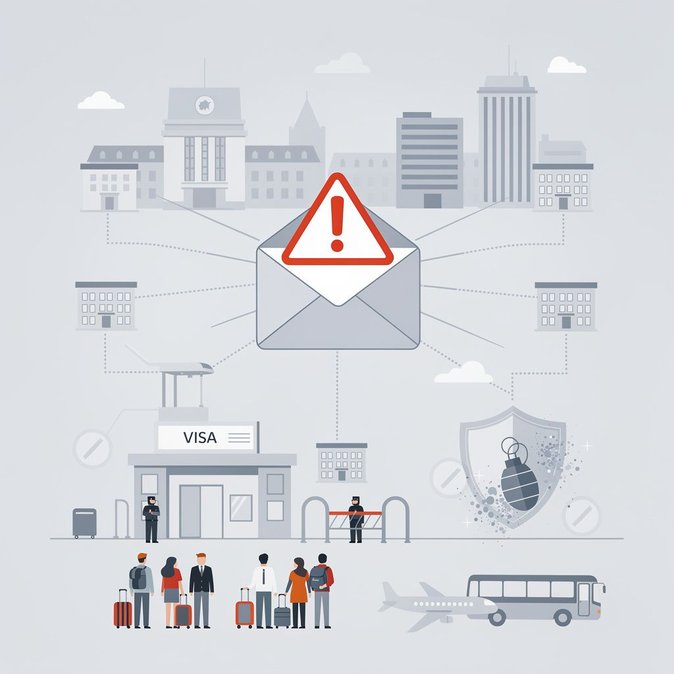
Police units across the Czech Republic spent much of Monday morning responding to a coordinated e-mail bomb threat sent to roughly 400 recipients, including ministries, labour offices, district authorities and several regional shopping malls. Although investigators quickly assessed the credibility of the threat as low, dozens of buildings—among them the Environment Ministry in Prague—were evacuated while explosives teams and sniffer dogs conducted sweeps. For people on the move, the disruption was tangible: queues formed at Prague’s major government counters handling passport renewals and residence-permit pickups as staff were sent home; several visa-appointment windows scheduled for Monday afternoon were postponed. While Czech Rail and Prague Airport reported no direct impact, security officers introduced random baggage checks at main rail hubs and motorway rest areas as a precaution. Travellers heading to foreign embassies in the capital also encountered perimeter controls that added up to 30 minutes to entry procedures. The incident highlights the growing intersection of security and mobility. In the past two years, similar hoax alerts in neighbouring Poland and Germany led to temporary border-checkpoint closures, underscoring how even low-credibility threats can ripple through Schengen’s frictionless travel ecosystem. Czech authorities said they would share forensic data with Europol and keep heightened vigilance at land borders with Slovakia, Austria and Germany for at least 48 hours. Businesses relying on in-person government services—such as the issuance of employee cards for non-EU staff—should monitor rescheduling notices and build extra lead time into compliance calendars this week. The Interior Ministry advised applicants whose appointments were cancelled to await new dates by e-mail rather than visiting offices in person. Although operations largely normalised by late afternoon, Monday’s scare serves as a reminder that contingency planning for sudden security alerts is now an essential part of corporate mobility programmes.
Source: Expats.cz