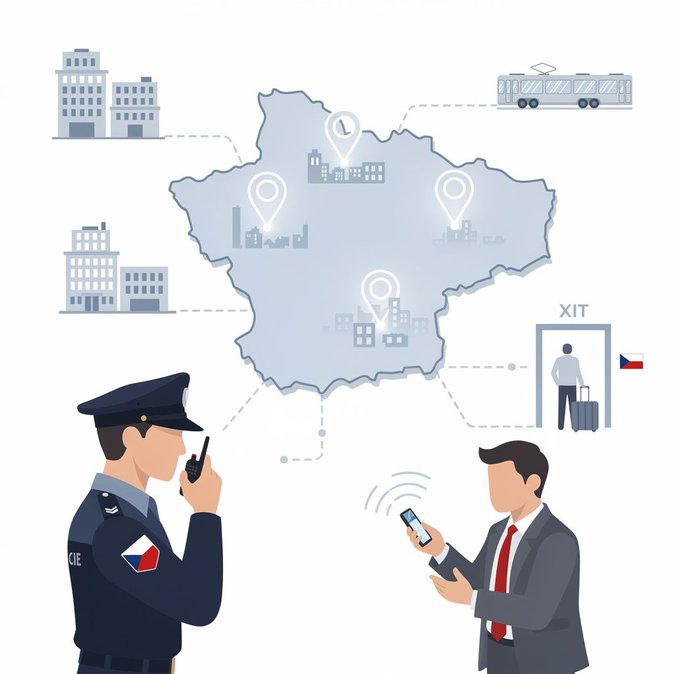
Czech business travellers and residents experienced an unusual security scare on 27 July when police ordered searches of roughly 400 locations across the country following an anonymous bomb threat. Targets included several ministries, town halls, shopping centres, railway stations, and university campuses. According to the national police presidium, building operators were contacted individually and asked to keep premises open while uniformed and plain-clothes officers conducted on-site sweeps. No explosive devices were found, but the sheer scale of the operation meant intensified police presence in Prague, Brno, Ostrava and other regional hubs for most of the day. Although authorities assessed the threat as “low risk”, the alert caused intermittent evacuation drills, traffic slow-downs near large office complexes, and short-notice security checks at Prague’s Václav Havel Airport rail link and metro stations. For international companies operating in the Czech Republic the episode was a timely reminder to review crisis-communication chains and employee location-tracking protocols. Airlines flying into Prague issued standard advisories urging passengers to arrive early, although flight schedules were unaffected. The bomb threat comes as Czech security services place growing emphasis on “soft-target” protection ahead of Prague’s busy late-summer conference season. In the first half of 2026 the Interior Ministry ran 46 joint exercises with private-sector facility managers to test evacuation and access-control procedures. Tuesday’s real-world test highlights how quickly such plans may need to be activated and why multilingual notification templates are essential for offices employing foreign staff. For global-mobility managers the practical takeaway is that business visitors should carry an ID at all times, keep local emergency numbers handy (112 or 158) and expect ad-hoc bag checks in public buildings over the coming weeks while the police investigation continues. Employers are advised to update travel-risk assessments and remind foreign assignees that Czech data-privacy rules allow police to request proof of accommodation during extraordinary security operations.
Source: Anadolu Agency