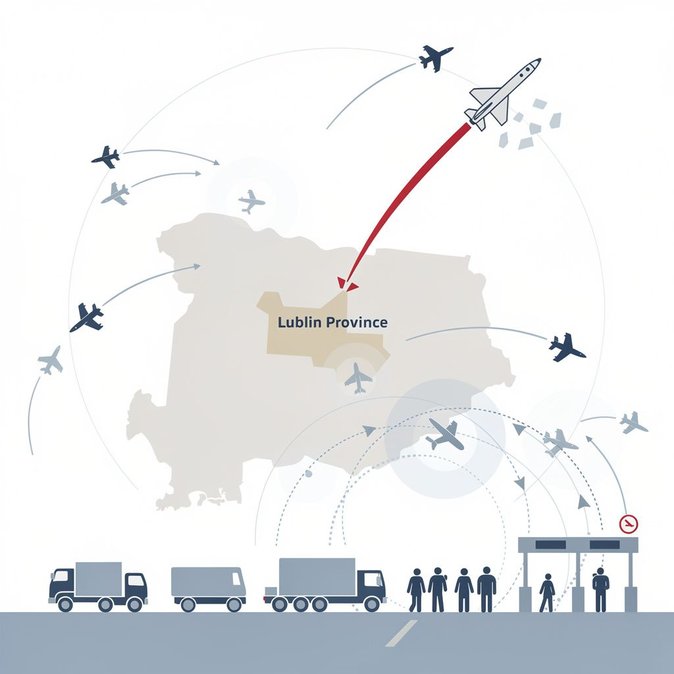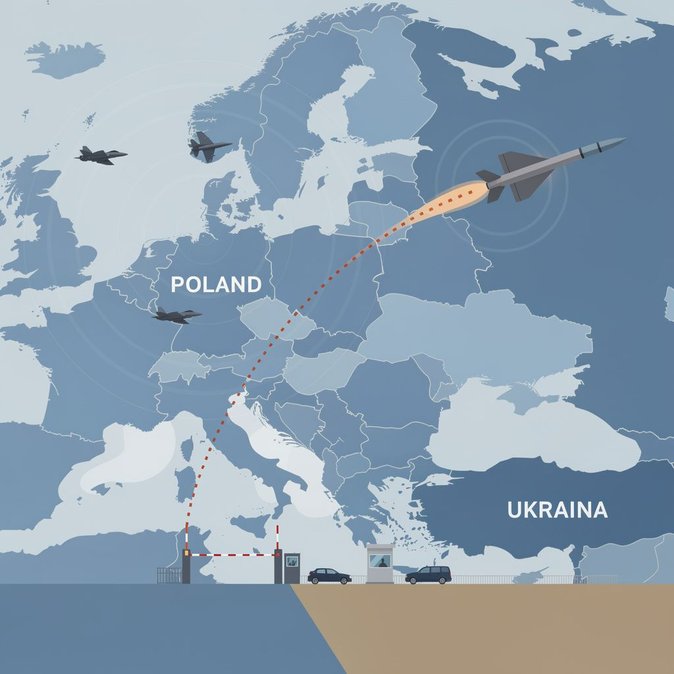
A predawn Russian missile strike on July 30, 2026 sent one Kh-101 cruise missile off course and across the Ukrainian–Polish frontier, setting off sirens in eastern Poland and triggering an immediate NATO air-policing response. Polish and NATO officials confirmed that the projectile penetrated Polish airspace for less than a minute before disappearing from radar and apparently crashing in open farmland in Lublin Voivodeship. No casualties or infrastructure damage were reported, but investigators recovered metallic fragments that the Polish Armed Forces say are consistent with a Kh-101 long-range cruise missile. The incident underscores how the four-year-old war in neighbouring Ukraine continues to ripple into Poland’s security calculus. Since 2022 Poland has transformed itself into a logistical hub for Western military aid and a principal sanctuary for over 1.3 million displaced Ukrainians. Border communities have long lived with the whine of NATO jets overhead, but Thursday’s scramble – two F-16s from Poznań-Krzesiny, an attack helicopter from Lublin, and additional surveillance aircraft – was the first real-world interception this summer. NATO Secretary-General Mark Rutte condemned the incursion as “a reckless act” and reiterated that the alliance “will defend every inch of allied territory.” For business travellers and mobility managers, the immediate impact is a temporary uptick in threat levels along Poland’s eastern flank. The Government Security Centre did not close airspace, but it issued a NOTAM urging civilian crews to remain in contact with Warsaw FIR controllers and be prepared for sudden reroutes. Rail operators suspended two morning Kyiv–Warsaw services while tracks were inspected for debris. Road freight through the Dorohusk and Hrebenne border crossings was slowed by additional inspections, causing queues of up to four hours for trucks heading into Ukraine. Corporate security advisers are reminding multinational firms with staff in eastern Poland to review shelter-in-place protocols and to ensure that travellers’ trip-tracking apps are enabled. Insurance underwriters say the event is unlikely to alter premiums immediately, but repeated violations could prompt a reassessment of war-risk surcharges on flights serving Warsaw, Rzeszów and Kraków. Meanwhile, the Ministry of the Interior has ordered a 48-hour surge deployment of Border Guard personnel and mobile radar units near the Lviv–Lublin corridor – a move that could further lengthen processing times at smaller road crossings. Strategically, the episode reinforces Poland’s argument for bolstering Ukraine’s air-defence umbrella: Prime Minister Donald Tusk, who met President Volodymyr Zelenskyy in Lublin only hours before the strike, told reporters that “every shortfall in Ukrainian air defence becomes an immediate threat to Poland and the entire Schengen area.” Diplomats in Brussels expect Warsaw to use the incident to press for faster deployment of Patriot and SAMP/T batteries along NATO’s eastern frontier and to advocate for accelerated EU funding for the bloc’s new Integrated Border Surveillance System, elements of which Poland is already piloting.
Source: Associated Press