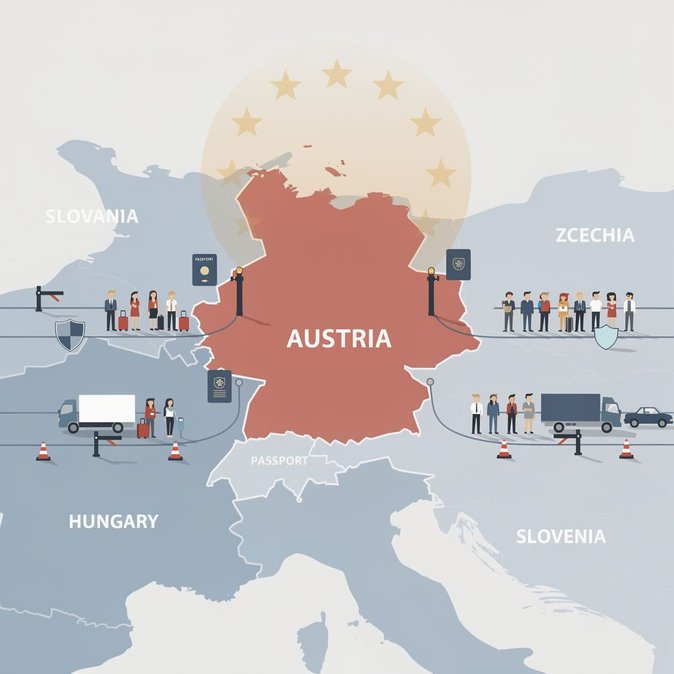
Austria has formally notified the European Commission that it will prolong the temporary re-introduction of border controls on its land and river frontiers with Slovakia as well as on its land borders with Czechia, Hungary and Slovenia for another six-month period, running from 16 September 2026 through 15 March 2027. The measure replaces the three-month cycle that expired at midnight on 15 September and aligns Vienna with neighbouring Germany and Italy, which also renewed internal controls this week. The Interior Ministry argues that continued pressure along the Western Balkan migration route, strained asylum-reception capacities and the broader security fallout from Russia’s war on Ukraine and unrest in the Middle East justify the extension. During the summer, Austrian police reported a 12 % rise in irregular entries compared with the same period in 2025, despite intensified joint patrols with neighbouring states. Business federations had lobbied for clearer timelines, warning that ad-hoc renewals complicated supply-chain planning for cross-border commuters and logistics companies. Practically, the decree means that motorists and rail passengers should keep expecting spot checks at the main crossings—particularly on the A4 (Hungary), A5 (Czechia) and A9 (Slovenia) corridors—although officials stress that “risk-based” screening will minimise delays for frequent travellers and trade flows. Travellers remain obliged to carry either a passport or national ID card; non-EU citizens must be able to present a valid visa or residence permit and proof of onward travel and funds. For multinationals operating plants in the Vienna–Bratislava “Twin-City” region, the biggest concern is employee punctuality. Several firms have reinstated flexible start times or provided shuttle buses with buffer time. Trucking companies advise drivers to budget at least 20–30 minutes additional transit time at peak periods. Airlines will also continue to perform outbound document screening for flights to Schengen destinations originating at regional airports in eastern Austria. Policy analysts note that Austria’s repeated use of Articles 25a (4) and (5) of the Schengen Borders Code signals that long-term reform—rather than rolling short-term renewals—may be on the horizon. A Commission review is expected early 2027; failure by member states to wind down controls could prompt calls for tighter EU-level oversight or even infringement proceedings.