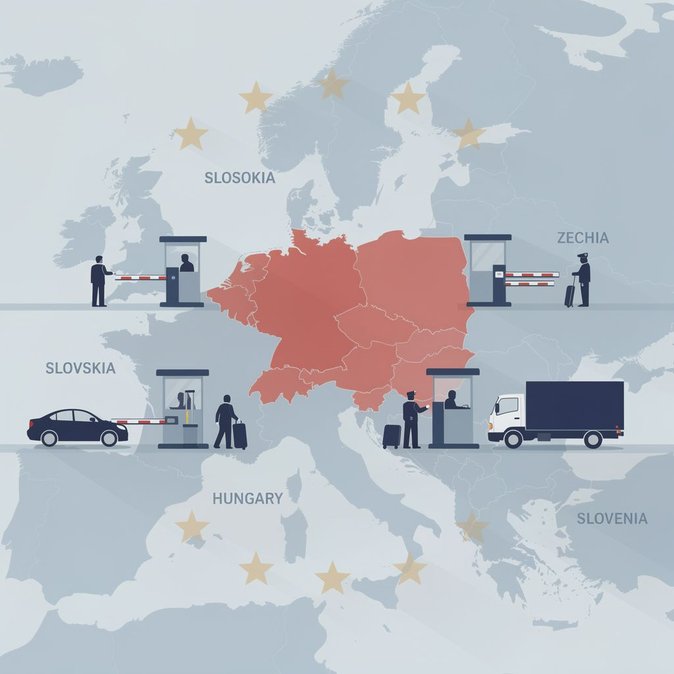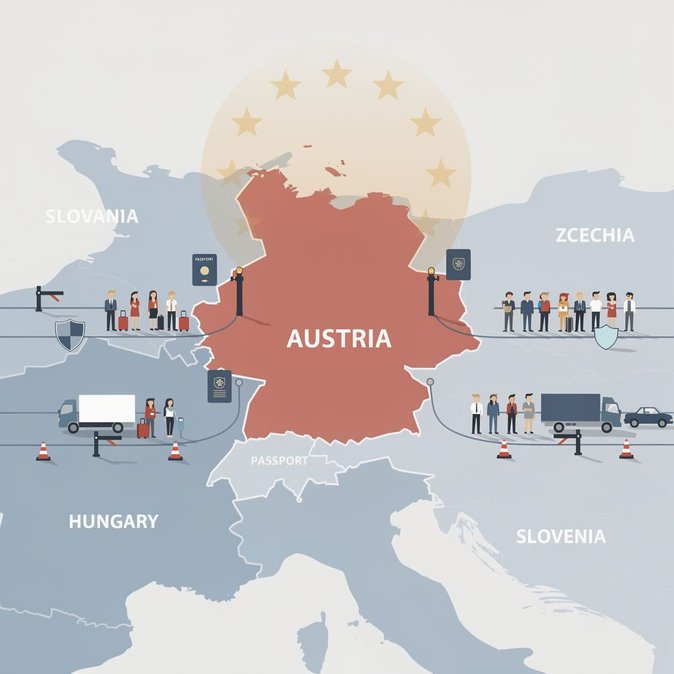
Austria has notified the European Commission that it will renew internal Schengen border controls for another six-month period, running from 16 September 2026 to 15 March 2027. The measure, which affects the land and river borders with Slovakia and the land borders with Czechia, Hungary and Slovenia, is justified by Vienna as a response to “continuous threats to internal security” posed by irregular migration along the Balkan routes, pressure on reception facilities, and wider geopolitical risks ranging from Russia’s war in Ukraine to tensions in the Middle East. The extension means that travellers—including EU citizens—will continue to face systematic checks at the affected crossings. Although Austria is required under the Schengen Borders Code to ensure controls are targeted and proportionate, businesses have warned that prolonged checks add time and cost to cross-border supply chains. Logistics associations estimate that each freight shipment to or from Austria now loses an average of 25 minutes at the frontier, translating into higher transport prices that are ultimately passed on to exporters and consumers. Interior-Minister Gerhard Karner defended the decision, arguing that “secondary movements” of asylum seekers have begun to rise again after this summer’s spike in arrivals to Spain’s North African enclave of Ceuta and that Austria “cannot afford to let reception centres become overwhelmed”. The government also pointed to a 37 % drop in irregular border apprehensions since controls were re-introduced, saying this proves the deterrent effect. Critics counter that controls undermine Schengen’s core principle of free movement and hurt border-region economies that depend on commuter traffic. Companies with cross-border staff movements should continue to factor in buffer times and carry documentation that proves the purpose of travel. HR departments are also advised to remind employees that random vehicle searches—including of company cars—remain legal inside a 30-km strip behind the frontier. Multinationals transferring goods between Austrian plants and subsidiaries in neighbouring countries may wish to explore alternative rail corridors or reschedule just-in-time deliveries outside of peak traffic hours. In parallel, Brussels is reviewing long-term reforms to the Schengen Borders Code that could limit repeated extensions beyond two years. If adopted, those rules would oblige Austria to phase out the controls or replace them with more targeted police checks in the interior. For now, however, the message to travellers is clear: document inspections at Austria’s eastern and southern borders will continue well into the first quarter of 2027.
Source: European Commission – DG HOME