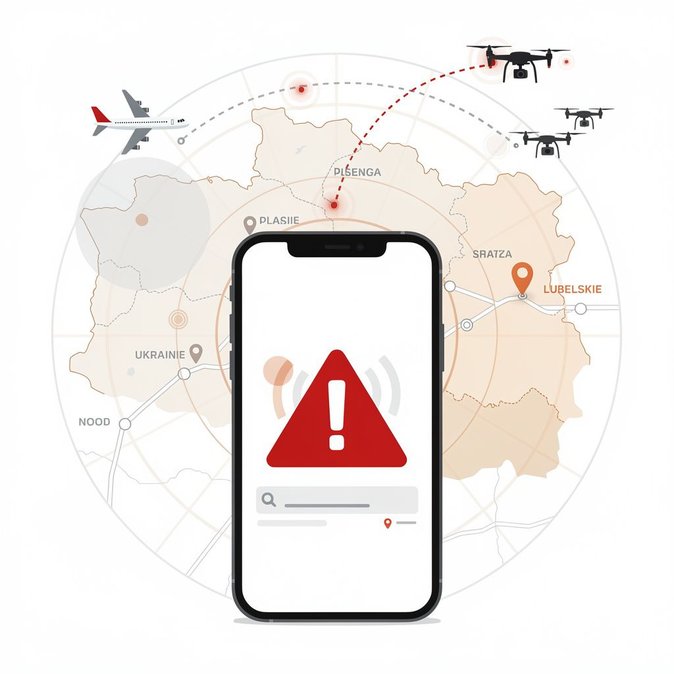
Residents and travellers in Lubelskie Voivodship awoke on 23 September to a shrill tone on their mobile phones: the Government Security Centre (RCB) issued a region-wide warning advising people to remain indoors and follow instructions from local authorities. The alert was triggered after Russian drones launched against targets in western Ukraine prompted Polish air-defence forces to activate heightened readiness protocols. While RCB alerts are not uncommon along Poland’s eastern flank, this was the first time in six weeks that the system covered the entire voivodship, including the city of Lublin and busy transit corridors toward Warsaw. The message, disseminated in Polish, English and Ukrainian, cautioned road users that temporary closures of sections of the S-12 and DK-17 highways could occur without notice to allow military convoys. For multinational companies with staff or dependants in the area, the alert emphasises the need for multi-language crisis-communication channels and go/no-go decision frameworks. HR managers should confirm that expatriates’ phones are configured to receive CB messages (enabled by default on Polish SIM cards since 2025) and that emergency contact trees are current. Travel-risk specialists recommend monitoring PANSA NOTAMs as well, as airspace restrictions often accompany RCB alerts. In the broader context, Poland’s civil-protection authorities continue to refine their public-warning capability in cooperation with EU Civil Protection Mechanism partners. The system can now geo-fence messages down to individual counties, a feature expected to benefit cross-border commuters once the new Schengen emergency-information regulation enters into force in 2027.