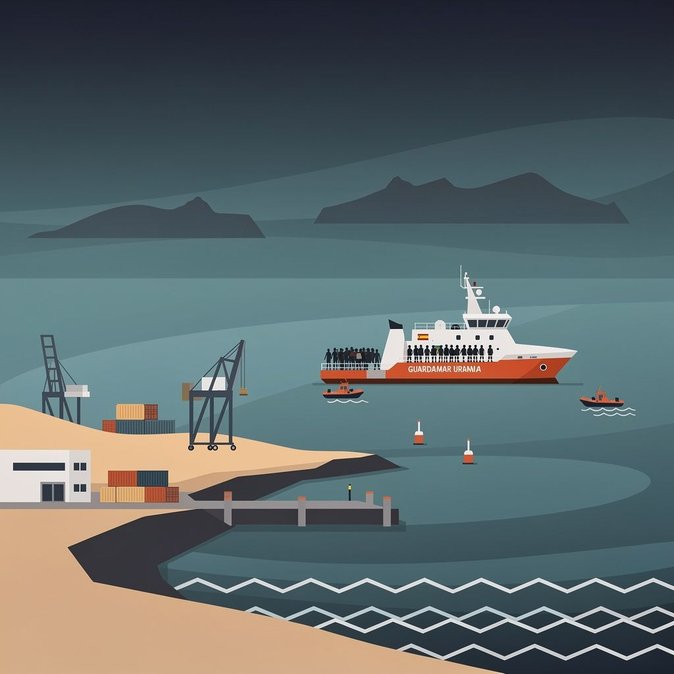
Salvamento Marítimo carried out its third rescue in less than twelve hours in Canary waters during the night of 25-26 September, after a fishing vessel alerted the maritime rescue coordination centre in Las Palmas to a small inflatable boat drifting 115 km east of Lanzarote. At 22:45 the rescue craft Guardamar Urania was dispatched and located the rigid-hulled dinghy shortly after midnight. Forty-one people—36 men, three women and two minors of sub-Saharan origin—were taken on board and provided with thermal blankets, drinking water and first-aid supplies. According to medical staff none required hospitalisation, although several showed symptoms of hypothermia and dehydration after at least two days at sea. The vessel reached Arrecife harbour at 02:30, where the regional health-emergency service (SUC), the Red Cross and the National Police activated the standard ‘humanitarian pier’ protocol. After triage and identification, the migrants were transferred to the Lanzarote reception centre, where they will begin an asylum screening and quarantine process that can last up to 72 hours. The latest landing illustrates the seasonal uptick on the so-called Canary Route from northwest Africa to Spain. Although total arrivals to the archipelago remain below last year’s peak, improved weather, economic instability in Senegal and Mauritania, and ongoing conflict in Mali are once again fuelling departures. For corporate mobility managers, the incident serves as a reminder that rescue operations can briefly close ports or divert coast-guard assets, causing knock-on delays to inter-island ferries and cruise calls at Arrecife. Local authorities reiterated calls for additional EU support to bolster reception capacity on smaller islands whose infrastructure is tailored to tourism rather than mass rescue. In the medium term, employers relocating staff to the Canaries should monitor the reopening—now postponed to November—of the Las Raíces macro-camp on Tenerife, which the Interior Ministry plans to keep as an overflow site in case arrivals accelerate in the fourth quarter.
Source: RTVC Canarias