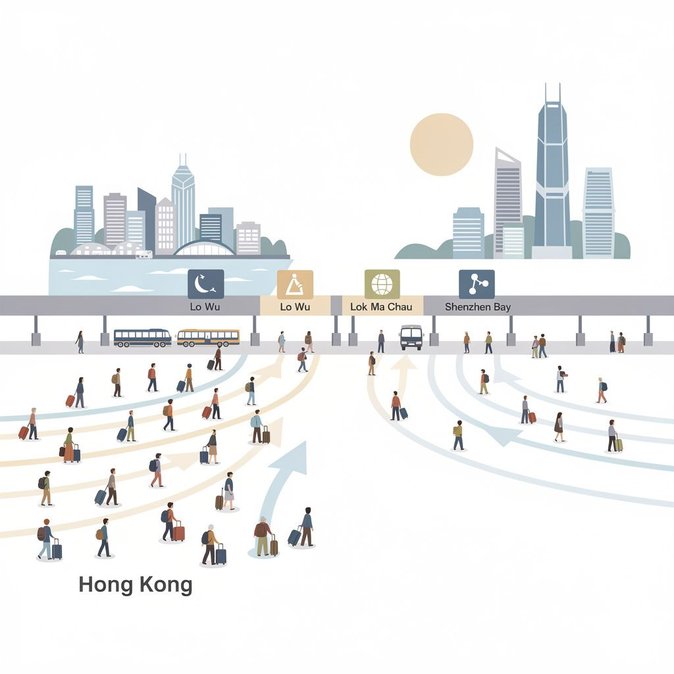
Hong Kong’s Secretary for Innovation, Technology and Industry, Sun Dong, has given the clearest timetable yet for opening the long-awaited “two-way fast-track” that will allow scientists, engineers and entrepreneurs to commute freely between the Hong Kong and Shenzhen halves of the Hetao Innovation and Technology Zone. Speaking on a Commercial Radio programme on Sunday, 27 September, the minister said the people-mobility component of the pilot must launch "no later than 30 June 2027"—matching an earlier pledge by Chief Executive John Lee to liberalise cross-border data flows by end-2026. Under the scheme, accredited researchers and start-up founders working in the Lok Ma Chau Loop will be able to use dedicated e-channels that combine mainland and Hong Kong immigration checks into a single inspection, similar to the “joint-inspection” model being introduced at the revamped Huanggang Port. The two governments are finalising a whitelist of eligible institutions and a multi-entry permit valid for stays of up to 30 days per trip. Sun revealed that semiconductor prototyping lines at the Hong Kong Microelectronics Research and Development Institute (MRDI) inside the zone will produce their first wafers this year. "Once we prove the technology, mass production can be relocated elsewhere in the Greater Bay Area, but the R&D brains must circulate daily across the river," he noted, underscoring the need for seamless mobility. Business groups welcomed the clarity. The Hong Kong Electronics Association said the half-year runway gives firms time to relocate project managers and arrange housing, schooling and insurance for cross-border assignees. Global law firm Baker McKenzie advised clients to review employment contracts and tax equalisation policies now, as dual payroll and social-security liabilities remain the biggest unknowns. If implemented on time, Hetao would become the first zone in China to integrate immigration, customs, tax, data-flow and intellectual-property regimes across two jurisdictions—providing a template that Beijing could replicate in other technology clusters.
Source: South China Morning Post