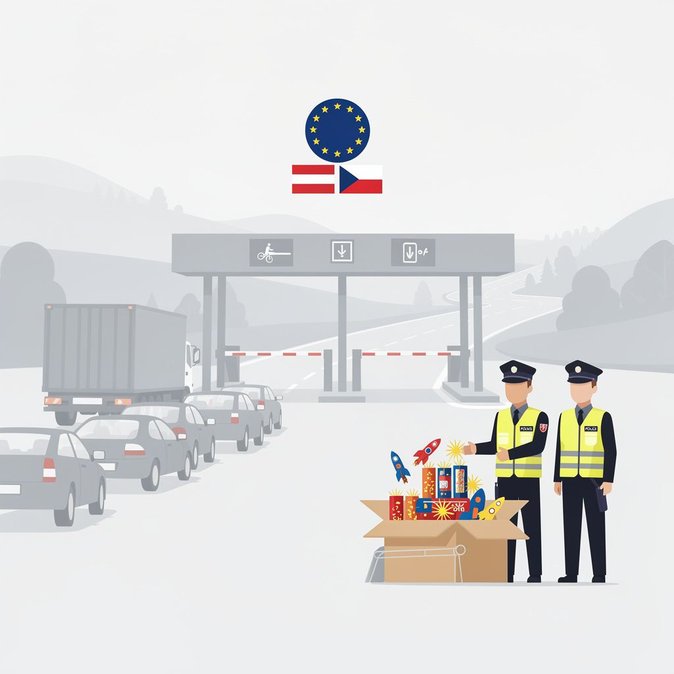
With Halloween and New Year’s Eve approaching, Austrian and Czech police have begun a coordinated three-day operation to curb the cross-border smuggling of high-powered fireworks. The campaign was announced on 13 October 2026 by Austria’s Director-General for Public Security, Michael Takács, after a planning session with his counterpart in Prague. Stations along the northern border—including the Haugsdorf/Hate and Kleinhaugsdorf crossings—are setting up mobile control lanes where officers inspect vehicles for pyrotechnics that exceed Austria’s strict category F2 limit. Austria’s Pyrotechnikgesetz requires a licence for fireworks with a net explosive content above 20 grams; however, such items are freely sold in Czech roadside shops, making the route a perennial headache for customs. Last year Austrian authorities seized more than 4.2 tonnes of illegal fireworks, many containing flash powder that can cause severe hand injuries. In addition to customs inspections, the joint task force is running foreign-police checks, alcohol tests and vehicle-safety reviews, ensuring the operation qualifies as a “mixed mobile unit” under Article 14 of the Schengen Borders Code. For travellers, the practical impact is longer waiting times—up to 30 minutes reported on the B 303 and S3 trunk roads—so logistics providers are being urged to build extra buffer into just-in-time deliveries from Czech suppliers. Employers that rely on commuter traffic from Moravia into Lower Austria, especially in the automotive and electronics sectors, should warn staff of the controls and remind them that unauthorised transport of fireworks can lead to fines of up to €10,000 and confiscation of the vehicle. Mobility compliance teams should also note that officers are using the stop-and-search authority under the Fremdenpolizeigesetz to check the immigration status of passengers. Third-country nationals found to be overstaying in any Schengen state risk a re-entry ban that could disrupt ongoing assignments. The operation illustrates how thematic law-enforcement actions—nominally about consumer safety—can still generate mobility friction at what is normally an open internal EU border. Similar blitzes are expected again in December, and may be replicated on Austria’s Slovak and Hungarian frontiers as the holiday season intensifies.
Source: Bundesministerium für Inneres