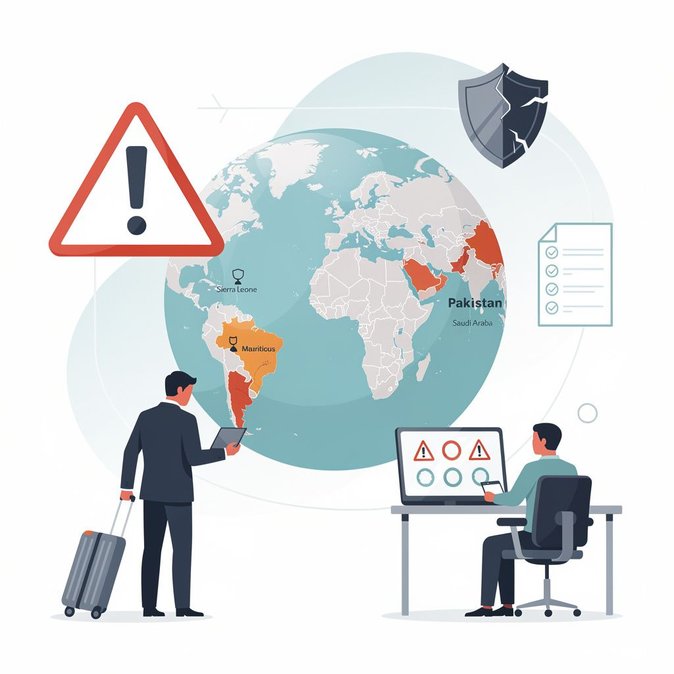
Australia’s Department of Foreign Affairs and Trade (DFAT) has issued fresh Smartraveller updates that raise the overall risk rating for four countries and therefore the requirements for Australian travellers and corporates with personnel on assignment. Effective 14 October 2026, Pakistan and Saudi Arabia have both been elevated to ‘Level 3 – Reconsider your need to travel’, while Sierra Leone now sits at ‘Level 2 – Exercise a high degree of caution’. Mauritius, long viewed as a low-risk holiday destination, has also inched upward but remains at ‘Level 1 – Exercise normal safety precautions’. The changes follow a series of security incidents—political unrest in Pakistan’s Khyber Pakhtunkhwa province, an escalation in drone attacks on Saudi infrastructure, renewed anti-government protests in Freetown, and severe weather disruptions in Mauritius—that DFAT says may affect Australians’ safety and access to consular support. For multinational companies the timing matters: many end-of-year project deployments and FIFO (fly-in fly-out) rotations from Australia ramp up in the fourth quarter. Corporate security managers must now update risk assessments, revise crisis-response plans, and check insurance coverage for any staff transiting the affected jurisdictions. In particular, the higher advisory level for Pakistan invalidates most standard corporate leisure-travel policies and may trigger additional approval steps for expense reimbursement. Travellers should note that elevated advisories can also influence airlines’ duty-of-care thresholds and may affect the availability of medical-evacuation cover. DFAT recommends all Australians register their overseas travel itineraries and subscribe to Smartraveller alerts so they can be contacted quickly in an emergency. Those already in the affected countries are urged to maintain high situational awareness, avoid large public gatherings and ensure that travel documents and visas remain valid at all times. While DFAT emphasises that advisories are not travel bans, history shows that Australian insurers and some government agencies use Level 3 as a tipping point for restricting non-essential travel. Companies with mobility programmes should therefore communicate the new ratings to travelling employees and consider offering flexible re-booking options or virtual alternatives where possible.
Source: DFAT – Smartraveller